
Here’s a conversation that happens in showrooms constantly.
Someone falls for a matte black faucet. It looks extraordinary against white tiles. They buy it, install it, and three weeks later they’re staring at chalky white streaks across it every single morning, wondering whether they made a mistake.
They didn’t make a mistake exactly. They made a choice without knowing what it required.
Ahmedabad has moderately hard water. So does most of Gujarat. That doesn’t rule out any finish — but it does change how much maintenance each one asks of you, and that’s information you deserve before buying rather than after.
What Hard Water Actually Does to a Faucet
Understanding the mechanism makes the finish choice obvious.
Hard water carries dissolved calcium and magnesium. When a droplet sits on a surface and evaporates, the water leaves — the minerals don’t. What remains is a chalky white deposit.
This causes three separate problems:
Visible spotting. The cosmetic issue everyone notices. Purely about appearance, and entirely about contrast between the deposit and the surface beneath it.
Aerator clogging. Mineral buildup inside the aerator restricts and distorts the water stream. This is a performance problem, and it’s the one most people misdiagnose as “low water pressure.”
Finish damage — usually self-inflicted. Here’s the part that matters most: hard water rarely damages a quality finish. The damage comes from what people use to remove the limescale. Acidic descalers and abrasive pads strip and etch finishes permanently.
The limescale is temporary. The damage from removing it aggressively is not.
Finish Comparison for Hard Water
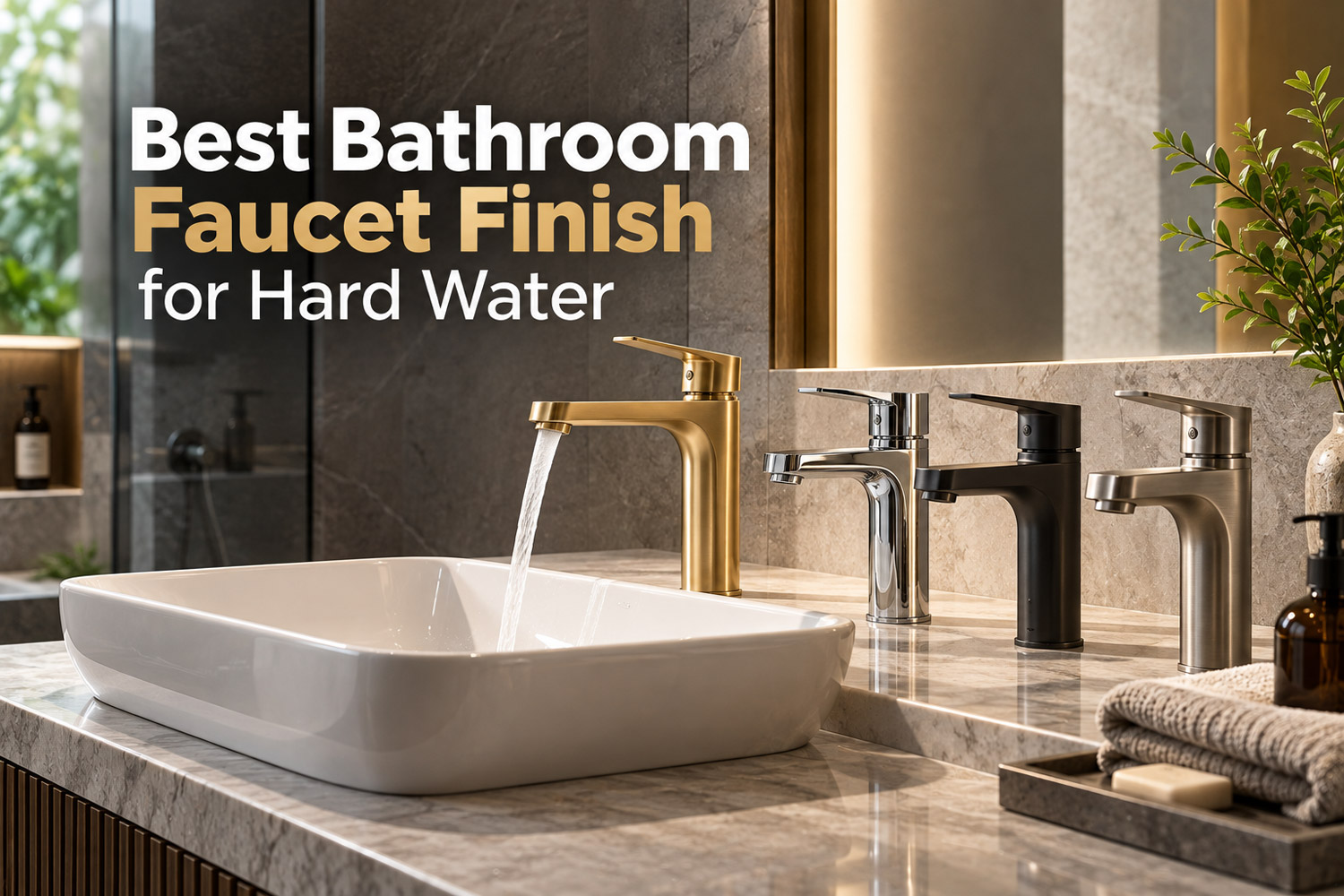
| Finish | Hides Water Spots | Hides Fingerprints | Cleaning Tolerance | Maintenance Level |
|---|---|---|---|---|
| Brushed Nickel | Excellent | Excellent | Good | Low |
| Brushed Gold | Excellent | Very good | Good (PVD) | Low |
| Gunmetal | Very good | Very good | Good (PVD) | Low |
| Polished Chrome | Good | Poor | Excellent | Low–Medium |
| Matte Black | Poor | Good | Moderate | High |
| Polished Gold | Moderate | Poor | Moderate | Medium–High |
Finish by Finish
Brushed Nickel — The Practical Winner
If minimum maintenance is your priority, this is the answer.
The brushed texture scatters light across the surface, which means water spots and fingerprints simply don’t register visually the way they do on a smooth surface. It’s warmer than chrome, more subtle than black, and it coordinates with almost any tile and sanitaryware combination.
Trade-off: It’s understated. If you want the faucet to be a design statement, this isn’t it.
Brushed Gold / Champagne Gold — Warm and Forgiving
Increasingly the most requested premium finish, and genuinely well-suited to hard water.
The brushed texture hides spotting effectively, and the warm tone means light-coloured mineral deposits contrast far less than they would against black. Against white sanitaryware and natural stone, it looks considerably more expensive than chrome.
Critical requirement: insist on PVD. Electroplated gold in a wet, hard-water bathroom will not hold up. PVD gold will. This is the finish where the coating process matters most — and where the price difference between good and cheap is most consequential.
Gunmetal — Sophisticated Middle Ground
Darker than chrome, softer than black. Hides spotting well because of the brushed texture, and the mid-tone means limescale doesn’t contrast sharply.
Excellent for transitional bathrooms that want depth without the maintenance demands of full matte black. Usually PVD-finished, which adds durability.
Polished Chrome — The Reliable Default
Chrome gets dismissed as boring. In hard water conditions, it’s quietly one of the most sensible choices available.
Why it works: Chrome is light and reflective, so white mineral deposits blend rather than contrast. And crucially, chrome tolerates cleaning better than any other finish — it’s the most chemically stable option, so occasional firmer cleaning won’t ruin it.
Weakness: Fingerprints show clearly on the reflective surface. In a family bathroom with children, you’ll be wiping often — though wiping chrome is easy and low-risk.
Matte Black — Beautiful, Demanding
Let’s be direct about this one.
Matte black is the most visually striking finish available and the hardest to maintain in hard water. White limescale against a black surface is maximum contrast — every droplet mark shows.
It’s still a valid choice. Plenty of people install matte black in Ahmedabad and love it. But go in knowing:
- It needs wiping after use to look its best
- Quality matters enormously — cheap matte black coatings fade and wear at contact points
- Never use abrasive cleaners; they scuff matte surfaces permanently
- It looks its absolute best in low-use bathrooms and photographs
Where it works well: Powder rooms, guest bathrooms, and primary bathrooms belonging to people who genuinely enjoy maintaining them.
Where it struggles: Busy family bathrooms where nobody wipes anything.
Polished Gold — Highest Maintenance
Polished gold is reflective, warm, and dramatic. It also shows both fingerprints and spotting, and requires PVD to survive a bathroom environment at all.
Beautiful in the right setting, but only if you’re prepared for the upkeep.
PVD vs Electroplating: The Difference That Matters Most
Two faucets can look identical on the shelf and behave completely differently after two years. The reason is usually the coating process.
Electroplating deposits a thin metal layer onto the base through an electrochemical bath. It works, it’s the industry standard for chrome, and it’s adequate — but the layer is comparatively soft and vulnerable to chemical attack.
PVD (Physical Vapour Deposition) vaporises the coating material in a vacuum chamber and bonds it to the base at a molecular level. The result is dramatically harder, more scratch-resistant, and far more chemically stable.
Why this matters in hard water:
PVD finishes tolerate cleaning that would degrade electroplated ones. They resist the gradual dulling that affects plated finishes in constantly wet environments. And they hold colour — particularly important for gold, gunmetal, and black, where fading is the most common long-term failure.
The practical rule: For chrome, quality electroplating is acceptable. For any coloured finish — gold, black, gunmetal, nickel — insist on PVD. If a supplier can’t tell you which process was used, that itself is informative.
This connects to the broader question of what separates genuinely premium fittings from expensive-looking ones, which we cover in our guide to choosing premium bathroom fittings.
Browse the bath faucets range at NEXL, where PVD finishes are specified across the coloured options.
The Aerator: The Part Nobody Thinks About
The aerator is the small mesh insert at the faucet outlet. It mixes air into the stream, reduces splashing, and saves water.
In hard water, it’s also the first component to fail — mineral buildup clogs the mesh, and the stream becomes uneven, weak, or sprays sideways.
Most “low water pressure” complaints are actually a clogged aerator.
What to look for:
Branded aerators. Neoperl is the benchmark, and quality faucets specify it. The mesh geometry resists scaling better than generic alternatives, and replacements are available years later.
Easy removal. You should be able to unscrew and clean the aerator with a simple tool. If it’s not removable, you can’t maintain it.
Anti-limescale design. Some aerators use flexible silicone nozzles that release deposits when rubbed with a finger. Genuinely effective in hard water.
Maintenance: Unscrew, soak in warm water, brush gently, reinstall. Every three to six months in hard water areas. It takes five minutes and restores the stream completely.
How to Clean Faucets Without Destroying Them
This section matters more than the finish choice itself, because most finish damage is caused by cleaning.
Do
Wipe dry after use. The single most effective habit. Water that doesn’t sit doesn’t leave deposits. A cloth near the basin makes this realistic.
Use mild soap and warm water. For routine cleaning, this is sufficient for every finish.
Use a soft microfibre cloth. Never abrasive pads, never scouring sponges.
Dry after cleaning. Don’t let cleaning water evaporate on the surface — that’s how you create the spots you just removed.
Don’t
Don’t use acidic descalers. Vinegar, lime removers, and commercial descaling products etch and strip finishes. They’ll remove the limescale and take the finish with it. This is the most common cause of ruined faucets.
Don’t use bleach or ammonia. Both attack finishes, particularly PVD coloured ones.
Don’t use abrasives. Scouring powders and abrasive pads scratch every finish, and permanently dull matte and brushed ones.
Don’t spray cleaner directly onto the faucet. Apply to the cloth instead — direct spray runs into joints and seals where it sits and causes damage you won’t see until it matters.
Don’t ignore the manufacturer’s guidance. Different coatings have different tolerances. When in doubt, mild soap and water is always safe.
For Established Limescale
If buildup is already significant, the honest answer is that there’s no aggressive shortcut that doesn’t risk the finish. Repeated gentle cleaning with mild soap, warm water, and patience is the correct approach.
For a specific product, ask the manufacturer what they approve. Using something they don’t will usually void the finish warranty.
Reducing Hard Water Impact at Source
Finish choice manages the symptom. These address the cause.
Inline filters. Fitted at the supply point, these reduce mineral content reaching your fittings. The most targeted intervention, and worth considering for thermostatic systems and smart toilets where internal components are harder to service.
Whole-house water softeners. The comprehensive solution. Significant investment, but it protects every fitting, appliance, and shower system in the house, plus your geyser.
Shower filters. Point-of-use filters for shower outlets. Less effective than whole-house treatment, but inexpensive and simple to fit.
The realistic assessment: for most homes, choosing a forgiving finish and wiping it dry is sufficient. Water treatment makes sense when hardness is severe or when you’ve invested in fittings and appliances worth protecting.
Matching Finish Across the Bathroom
Whatever finish you choose, apply it consistently.
Your faucets, shower controls, flush plate, towel rails and accessories, and visible bottle trap should all share one finish family.
The bottle trap is the most forgotten item. Under a wall hung basin it’s fully visible, and a chrome trap under a matte black faucet undermines everything else you got right. Specify it with the faucet, not afterwards.
One practical note: finishes vary slightly between manufacturers. If you’re mixing brands, see the pieces together in person before committing — particularly for gold and gunmetal, where tonal variation is most noticeable.
Quick Recommendation by Situation
Busy family bathroom, minimum maintenance: Brushed nickel or polished chrome.
Premium look, manageable upkeep: Brushed gold (PVD) or gunmetal (PVD).
Maximum visual impact, willing to maintain: Matte black.
Guest bathroom or powder room: Any finish — low use means low maintenance regardless.
Commercial washroom: Polished chrome. Most durable under aggressive cleaning regimes.
See Finishes in Your Own Lighting
Finish is the hardest thing to judge from a photograph. Screen calibration alters colour, showroom lighting differs from bathroom lighting, and brushed textures don’t photograph at all — they have to be seen.
At NEXL’s Experience Center in Ahmedabad, faucets are displayed across finish options alongside coordinating sanitaryware and accessories, so you can compare directly and decide what will actually work in your bathroom.
NEXL Experience Center 111, Sun Orbit, Rajpath Rangoli Road, PRL Colony, SBR, Ahmedabad, Gujarat – 380059
Walk-ins welcome. For renovation projects or trade enquiries, get in touch to arrange a consultation.
Explore online:
FAQ’s
Q: Can I use vinegar to clean limescale off my faucet?
A: It’s not advisable. Vinegar is acidic and will etch or strip most finishes, particularly PVD coloured ones and matte surfaces. It removes the limescale and damages the faucet underneath. Mild soap, warm water, and drying after use is the safe approach.
Q: Will matte black faucets fade over time?
A: A quality PVD matte black finish holds colour well for years. Cheap coatings fade and wear at high-contact points like handles. This is the finish where paying for quality makes the most visible difference.
Q: How often should I clean the aerator?
A: Every three to six months in Ahmedabad’s water conditions. If the stream becomes uneven or weaker, clean it immediately — that’s the aerator telling you it’s clogged.
Q: Is brushed gold the same as polished gold?
A: No. Brushed gold has a textured matte surface that diffuses light and hides spotting. Polished gold is reflective and shows both fingerprints and water marks. For hard water, brushed is substantially more practical.
Q: Can I mix chrome and matte black in one bathroom?
A: It can be done deliberately — for example, chrome fittings with black accessories as a considered contrast. But done accidentally, it reads as an oversight. If you’re unsure, stay with one finish family.
Q: Does a more expensive faucet resist hard water better?
A: Not automatically, but usually. Premium faucets typically use PVD coatings and quality aerators, both of which handle hard water considerably better. Check the specifications rather than assuming price alone indicates it.
Every finish works in hard water. They just ask for different amounts of attention.
Choose brushed if you want it to look good with minimal effort. Choose chrome if you want the most forgiving surface to clean. Choose matte black if you love it enough to wipe it — which is a completely legitimate reason.
The mistake isn’t picking a demanding finish. It’s picking one without knowing it was demanding.
Explore the full bath faucets range at nexl.in/product-category/bath-faucets/