
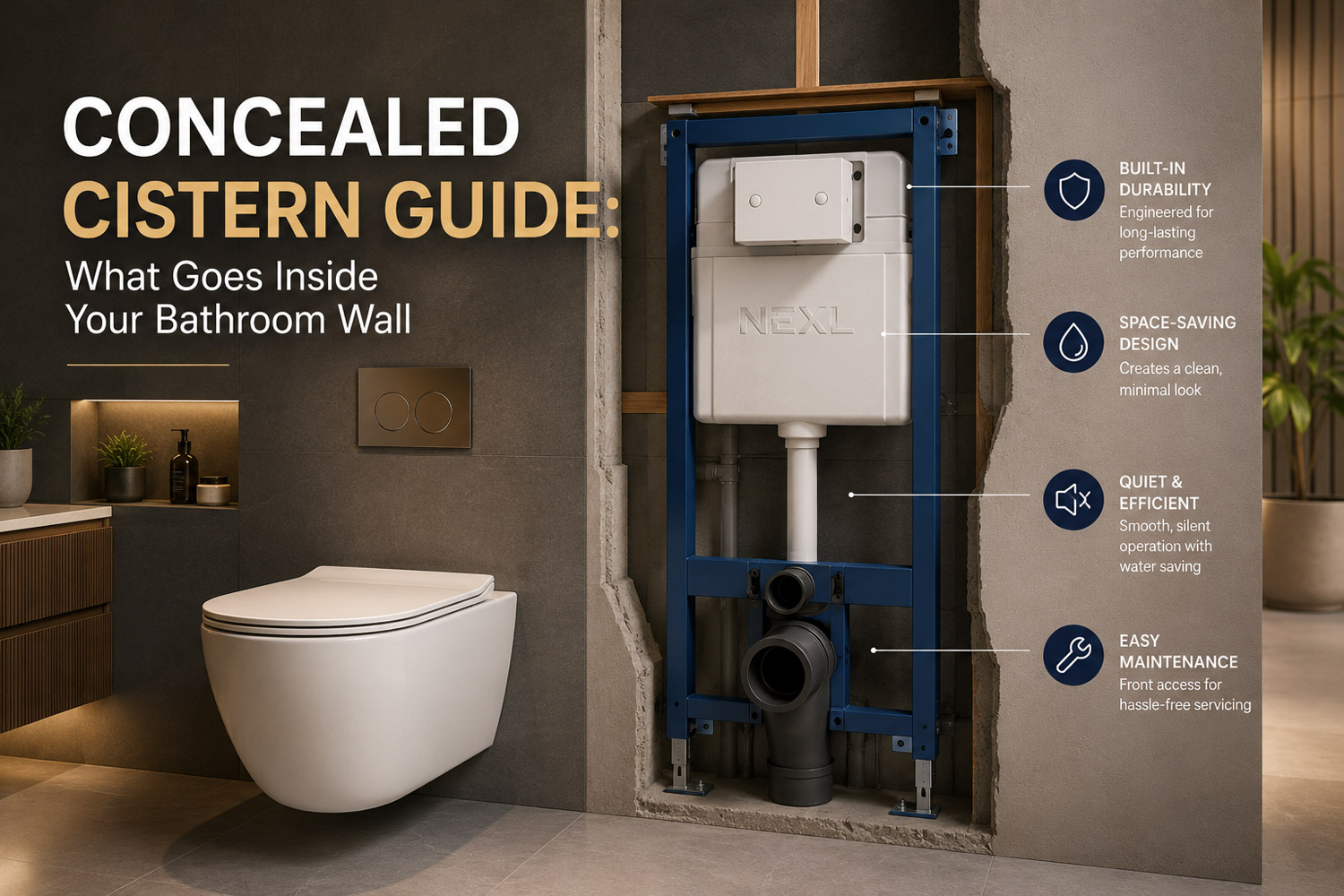
There’s one component in a modern bathroom that you buy, install, and then never see again for fifteen years. It sits sealed inside a wall behind tiles, doing its job several times a day, entirely invisible.
Which is exactly why people underspend on it.
The concealed cistern is the least glamorous purchase in a bathroom renovation and one of the most consequential. Get it right and you’ll forget it exists. Get it wrong and fixing it means breaking tiles.
Here’s what actually matters when choosing one.
What is a concealed cistern?
A concealed cistern is a toilet water tank installed inside the wall rather than mounted visibly behind the pan. It consists of a water tank, a steel support frame, and a flush plate — the only visible element — set flush into the tiled wall surface.
How much wall depth does a concealed cistern need?
Most concealed cisterns need 150–200mm of cavity depth. Where no cavity exists, a false wall is built to house the unit — which also creates a useful ledge above for storage.
Can a concealed cistern be repaired without breaking tiles?
Yes, if it’s a quality unit. Well-designed concealed cisterns are serviced through the flush plate opening — the plate lifts out and gives access to the fill valve and flush mechanism. This serviceability is the main thing separating good cisterns from cheap ones.
Is a concealed cistern better than a visible one?
For appearance and cleaning, yes — nothing protrudes, nothing collects dust, and the flush is quieter. For cost and simplicity, a visible cistern wins. The choice depends on whether you’re renovating fully or replacing an existing setup.
How long does a concealed cistern last?
A quality concealed cistern lasts 15–20 years or more. Internal components like the fill valve or flush mechanism may need replacing once in that period, which is routine and done through the flush plate.
The Three Components
A concealed cistern isn’t a single product. It’s a system of three parts, and they’re often bought separately — which is where mismatches happen.
1. The Support Frame
A steel structure anchored to the floor and wall that carries the entire load of the toilet pan and its user. Quality frames are rated to 400 kg or more, adjustable for height, and galvanised against corrosion.
This is the structural component. When wall hung toilets fail, it’s almost always a frame that was undersized, poorly anchored, or skipped entirely.
2. The Cistern (Water Tank)
The tank itself, along with the fill valve and flush mechanism. This is where dual-flush functionality and water efficiency live, and where most component failures eventually occur.
3. The Flush Plate
The only part you ever see. It sits flush with the tiled wall and houses the flush buttons. Available in a range of finishes to coordinate with the rest of your fittings.
All three need to be compatible. Not every pan fits every frame, and not every flush plate fits every cistern. This is the single most common specification error.
Concealed vs Visible Cistern
| Factor | Concealed | Visible / Close-Coupled |
|---|---|---|
| Appearance | Nothing protrudes | Tank visible behind pan |
| Cleaning | No surfaces to dust around | Tank and pipework collect dust |
| Noise | Muffled by wall cavity | Audible refill |
| Space | Recessed into wall | Projects into room |
| Cost | Higher — frame + tank + plate | Lower — single unit |
| Installation | Needs wall cavity work | Straightforward |
| Servicing | Through flush plate | Fully accessible |
| Retrofit | Requires renovation | Simple replacement |
Concealed cisterns pair naturally with wall hung toilets, which is where most of their benefit comes from — the combination is what creates a fully clear floor beneath the pan.
What Separates a Good Concealed Cistern From a Cheap One
This is the part that matters most, because the differences are invisible at purchase and expensive later.
Serviceability Through the Flush Plate
The single most important feature.
A well-designed cistern lets you remove the flush plate and access the fill valve, float, and flush mechanism through that opening. Routine maintenance takes an hour and touches nothing else.
A poorly designed one requires opening the wall. That’s tiles, waterproofing, and a bathroom out of use for days.
Ask directly: “Can the fill valve be replaced through the flush plate?” If the answer is vague, that’s the answer.
Spare Parts Availability
The cistern will outlast its internal components. Confirm the manufacturer supports the model long-term and that valves and mechanisms are available separately.
A cistern with no spare parts isn’t a cistern with a long life — it’s a wall you’ll eventually break open.
Frame Load Rating and Build
Look for galvanised steel, adjustable feet, a 400 kg+ rating, and proper anchoring points for both floor and wall. The frame carries everything.
Dual Flush Mechanism
Standard on quality units — a full flush and a reduced flush. In a household of four, the water saved over a year is substantial. Look for a mechanism that actually stops cleanly rather than continuing to trickle.
Quiet Fill Valve
The wall cavity muffles noise, but a poor fill valve will still be audible — particularly at night, and particularly if the bathroom shares a wall with a bedroom.
Insulation Against Condensation
In humid conditions, cold water inside a warm wall cavity can cause condensation on the tank surface. Quality cisterns include insulation to prevent moisture accumulating inside your wall — which is not a problem you want developing invisibly.
Explore concealed cistern options within the sanitaryware range at NEXL.
Choosing Your Flush Plate
The flush plate is the only visible part of the system, and it’s routinely decided last — which is why it so often looks like an afterthought.
Match It to Your Fittings
Your flush plate should share a finish family with your basin mixers, shower controls, and accessories. Chrome, matte black, brushed gold, gunmetal — pick one and carry it through.
A chrome flush plate in a matte black bathroom is the kind of small inconsistency that undermines an otherwise well-executed room.
Consider the Format
Dual button — Two distinct buttons, clearest to use, most common. Split plate — Single plate divided into two pressure zones, cleaner appearance. Pneumatic — Air-actuated, allows the plate to sit away from the cistern for more layout flexibility. Sensor / touchless — No contact required. Increasingly specified in commercial washrooms and premium residential bathrooms.
Don’t Forget Ergonomics
The plate should sit at a comfortable height — typically around 1000mm from finished floor. Too high looks odd and is awkward for children; too low is uncomfortable to reach.
Installation: What Has to Happen and When
Concealed cisterns are unforgiving about sequence. Decisions made late become expensive.
Before Tiling — Non-Negotiable
Frame position and height. Determines seat height for the life of the bathroom. Standard is 400–420mm from finished floor to seat top, but this is adjustable — set it higher for taller users or elderly family members.
Waste outlet alignment. The pan connects to the waste at a fixed point inside the wall. This must be roughed in correctly.
Water supply connection. Routed to the cistern inlet before the wall closes.
Cavity depth confirmed. 150–200mm typically. If your wall doesn’t have it, a false wall gets built — plan this at design stage, not during installation.
Power supply, if you’re going smart. Smart toilets need an electrical point inside the wall. Adding this after tiling is a serious problem.
After Tiling
The pan mounts, the flush plate goes in, and the system is commissioned. This part is quick — everything difficult happened earlier.
Get It Professionally Installed
This is not a DIY component. Frame anchoring, waste alignment, and waterproofing around the cavity all need to be correct, and errors are only discoverable after the wall is closed. Poor installation also voids most manufacturer warranties.
Common Mistakes
Buying pan, frame, and plate separately without checking compatibility. The most frequent error. Confirm the full system works together before ordering anything.
Choosing on price alone. The cistern is inside your wall for fifteen years. Saving a small amount on a component you cannot easily reach is a poor trade.
Deciding the flush plate last. Decide it alongside your faucets, not after the tiling is done.
Not confirming serviceability. Ask specifically whether the fill valve is replaceable through the plate. If it isn’t, choose something else.
Skipping the wall structure check. Confirm your wall can take a frame before committing. A good supplier raises this unprompted.
Setting seat height by default. You get one opportunity. Think about who uses this bathroom now and in ten years.
Does a Concealed Cistern Suit Your Project?
Yes, if:
- You’re doing a full bathroom renovation
- You want a wall hung toilet — a concealed cistern is required
- The bathroom is compact and you want it to feel more open
- Cleaning ease is a genuine priority
Probably not, if:
- You’re replacing a toilet without renovating
- Wall structure is uncertain or problematic
- Budget is better allocated to fittings you use more often
- It’s a low-use guest bathroom
For a fuller comparison of the two formats, see our guide to wall hung vs floor mounted toilets.
See the System Before It Goes in the Wall
A concealed cistern is the one component you can’t inspect after installation. Which makes seeing it beforehand more important, not less.
At NEXL’s Experience Center in Ahmedabad, cistern systems are displayed alongside compatible pans and flush plates — so you can see how the components fit together, compare plate finishes against your chosen fittings, and confirm compatibility before anything is ordered.
NEXL Experience Center 111, Sun Orbit, Rajpath Rangoli Road, PRL Colony, SBR, Ahmedabad, Gujarat – 380059
Walk-ins welcome. For renovation projects or trade enquiries, get in touch to arrange a consultation.
Explore online:
Frequently Asked Questions
Q: What happens if a concealed cistern leaks inside the wall?
A: Quality cisterns are designed so the components most likely to fail — fill valve, flush mechanism, seals — are all reachable through the flush plate opening. Tank body failures are rare in well-made units. This is precisely why cistern quality matters more than its invisibility suggests.
Q: Can I install a concealed cistern in an existing bathroom without full renovation?
A: It requires opening the wall or building a false wall, plus relocating the waste connection. That’s renovation-scale work. Worth doing as part of a full bathroom project, rarely worth it alone.
Q: How do I know which flush plate fits my cistern?
A: Plates and cisterns are matched by manufacturer and model. Confirm compatibility at purchase — buying a plate separately without checking is a common and frustrating error.
Q: Do concealed cisterns save water?
A: Dual-flush models do, meaningfully. The reduced flush uses roughly half the water of a full flush, and most household flushes only need the reduced option.
Q: What if I want to change the flush plate later?
A: Straightforward, provided the new plate is compatible with your cistern model. The plate is designed to be removable — it’s the access point for servicing.
Q: Is a false wall a problem in a small bathroom?
A: It uses roughly 200mm of depth, but it typically creates a ledge above the toilet that becomes genuinely useful storage. In compact bathrooms this often nets out positive.
The concealed cistern is a rare category where the right decision is almost entirely about things you cannot see — serviceability, frame quality, spare part availability.
Spend the extra on the component going into your wall. Everything else in the bathroom can be changed later.
Explore the full sanitaryware range at nexl.in/product-category/sanitarywares/