
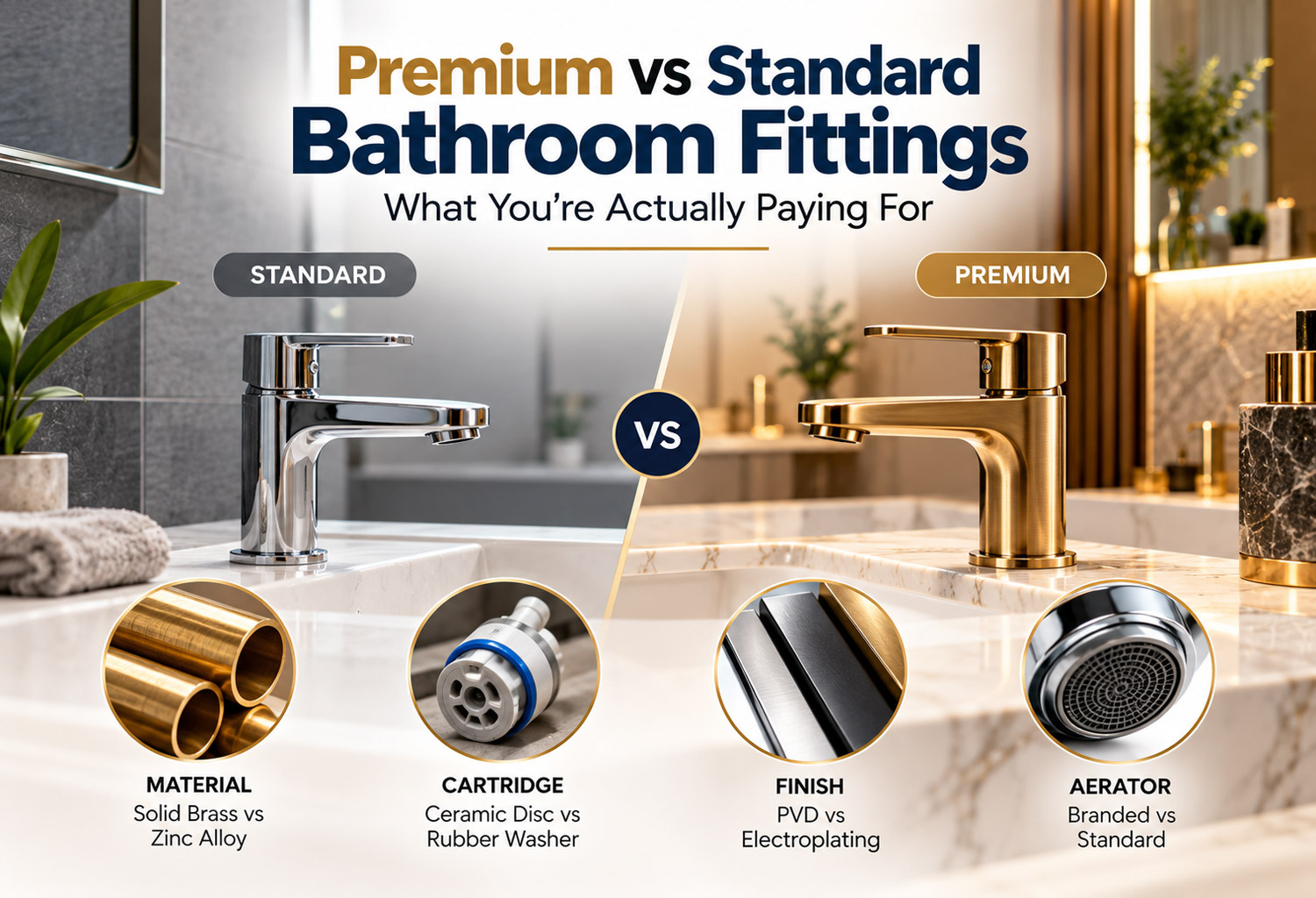
Two basin mixers sit side by side in a showroom. Same shape, same chrome finish, roughly the same size. One costs three times what the other does.
Nobody explains why. The salesperson says one is “better quality” and you are left deciding whether that is worth the difference or whether you are paying for a name.
It is a fair question, and it deserves a proper answer. The gap between premium and standard bathroom fittings is real, but it is not evenly spread across every product, and there are places where paying more genuinely does not make sense.
Here is what separates them, and where the difference actually shows up in daily use.
The Four Things That Actually Differ
Strip away the marketing and the real differences come down to four components. Everything else is cosmetic.
1. What the Body Is Made Of
This is the single biggest difference, and it is almost invisible on a showroom shelf.
Premium fittings use solid brass bodies. Brass handles constant moisture, resists corrosion, and copes with the repeated expansion and contraction that comes from hot and cold water cycling through it several times a day.
Standard fittings often use zinc alloy, and the cheapest use plated plastic with a metal-look coating. Both work on day one. The difference appears around year two or three, when zinc alloy starts to corrode at the threads and seals, usually showing up first as a slow weep at the base.
How to check it yourself: pick both up. Brass is noticeably heavier than zinc alloy of the same size. It is a crude test, but it works.
2. The Cartridge Inside
The cartridge is the mechanism that controls flow and mixing. You never see it, and it determines how the faucet feels every single time you use it.
Premium fittings use ceramic disc cartridges. Two polished ceramic discs slide against each other, sealing without rubber contact. They turn smoothly, shut off cleanly, and last for a very large number of cycles.
Cheaper fittings use rubber washer mechanisms. These wear down, and when they do the faucet starts dripping. Most people recognise the sound.
That smooth, weighted feel when you turn a good faucet is not a design flourish. It is the cartridge.
3. How the Finish Was Applied
Finish is not paint. It is a coating bonded to the metal, and there are two main ways of doing it.
Electroplating deposits a thin metal layer through a chemical bath. It is the standard process and it is perfectly adequate for chrome.
PVD, short for physical vapour deposition, bonds the coating at a molecular level inside a vacuum chamber. The result is far harder, resists scratching, and holds its colour.
This matters most for coloured finishes. Matte black, brushed gold, and gunmetal all fade or wear at contact points if they are only electroplated. On a PVD finish they hold up for years.
If you are choosing anything other than chrome, ask which process was used. A supplier who cannot tell you has told you something.
4. The Aerator
The aerator is the small mesh insert at the spout outlet. It shapes the stream, reduces splashing, and saves water.
In hard water, which covers most of Gujarat and much of India, it is also the first thing to clog. Premium fittings specify branded aerators, Neoperl being the common benchmark, with mesh geometry that resists scaling and replacements available years later.
Most complaints about weak water pressure in a bathroom are actually a blocked aerator. A good one stays clear longer and unscrews easily for cleaning.
What Does Not Justify a Higher Price
Being honest about this matters, because some price differences are not backed by anything.
Brand name alone. A recognisable name can mean better engineering, or it can mean a bigger advertising budget. Check the specifications instead.
Visual complexity. An elaborate shape does not make a faucet better. Some of the best engineered fittings look very plain.
Packaging and presentation. It has no bearing on how the product performs after installation.
Imported origin by itself. Country of manufacture tells you less than the actual material and cartridge specification.
Where Premium Is Worth It, and Where It Is Not
Not every fitting deserves the same spend. This is where most people allocate budget badly.
Spend more here
Shower systems. Mechanically the most complex item in the bathroom, used daily, and often partly buried in the wall. Replacing one later means breaking tiles. Thermostatic systems in particular reward the investment because temperature stability depends entirely on cartridge quality.
Basin mixers. The most frequently used fitting in any bathroom. If one thing makes you notice the quality of your bathroom every morning, it is this. Worth browsing the full bath faucets range before settling.
Anything concealed. Cisterns, valve bodies, and in-wall components should be the best you can afford. The cost of replacing them is not the part price, it is the tiling.
Spend less here
Accessories. Towel rails, hooks, soap dishes, and paper holders matter for the finished look, but they are surface mounted and easy to swap. If budget is tight, start modest here and upgrade later. The accessories range has options across price points.
Low-use bathrooms. A guest bathroom used twice a month does not need the same specification as a family bathroom used by five people daily.
The Cost Over Ten Years
Price comparison at the till is misleading because it ignores what happens afterwards.
A standard faucet that needs replacing twice in a decade costs you the unit price three times over, plus plumber call-outs, plus the disruption. A premium one installed well usually needs a cartridge replacement somewhere in that period, which is routine maintenance rather than failure.
There is also the part nobody prices. A tarnished, chipped faucet makes a well-finished bathroom look tired. That is not a repair cost, but it is a real one.
When Standard Fittings Are the Right Call
Premium is not automatically correct, and pretending otherwise would be dishonest.
Standard fittings make sense when the bathroom sees occasional use, when you are preparing a property for sale or rent rather than living in it long term, when a renovation budget is better directed at waterproofing and tiling, or when the fitting is a temporary measure before a planned renovation.
Getting the waterproofing right with standard fittings is a far better outcome than premium fittings over poor substrate work. The expensive mistakes in a bathroom are almost never the taps.
How to Tell Them Apart Without Taking Anything Apart
Four questions settle it:
- Is the body solid brass?
- Does it use a ceramic disc cartridge?
- Is the finish PVD or electroplated?
- Is the aerator branded, and are replacements available?
Any supplier selling genuinely premium fittings will answer all four without hesitation. Vague answers usually mean the specifications do not support the price.
For a fuller walkthrough of how to choose once you have decided on premium, our guide to choosing premium bathroom fittings covers water pressure, finishes, and budget allocation in detail.
See the Difference in Person
Weight, smoothness, and finish depth are difficult to judge from photographs, and impossible to judge from a specification sheet alone.
At the NEXL Experience Center in Ahmedabad, fittings are displayed alongside coordinating sanitaryware and accessories, so you can handle them, compare finishes under consistent lighting, and ask about the four questions above directly.
NEXL Experience Center 111, Sun Orbit, Rajpath Rangoli Road, PRL Colony, SBR, Ahmedabad, Gujarat 380059
Walk-ins are welcome, and for larger renovations or project work it is worth calling ahead to arrange a proper consultation.
Frequently Asked Questions
Are premium bathroom fittings worth it for a rental property?
Usually not throughout. A mid-range specification holds up well in rentals. If you do upgrade anything, make it the shower, since it gets the heaviest use and is the most disruptive to replace between tenancies.
How long do premium bathroom fittings last?
With quality materials and correct installation, premium fittings typically perform reliably for well over a decade. Cartridges may need replacing once in that time, which is normal maintenance rather than product failure.
Is an expensive faucet always a premium one?
No. Price can reflect design, brand positioning, or distribution costs rather than build quality. Check the body material, cartridge type, and finish process instead of relying on price as a proxy.
Can I mix premium and standard fittings in one bathroom?
Yes, and it is often sensible. Put the budget into the shower and basin mixer, and economise on accessories. Just keep every item in the same finish family so the bathroom still reads as one considered scheme.
What is the most common mistake when buying bathroom fittings?
Choosing on appearance alone and discovering the practical consequences later, usually around water pressure compatibility or finish maintenance in hard water.
Conclusion
The difference between premium and standard bathroom fittings is genuine, and it lives in four places: the body material, the cartridge, the finish process, and the aerator.
It is not evenly distributed though. The gap matters enormously on a shower system and barely at all on a towel rail. Spend accordingly, ask the four questions, and you will get a bathroom that still works properly in ten years without having overpaid for the parts where it made no difference.
Explore the full range at nexl.in/product-category/bath-faucets/