
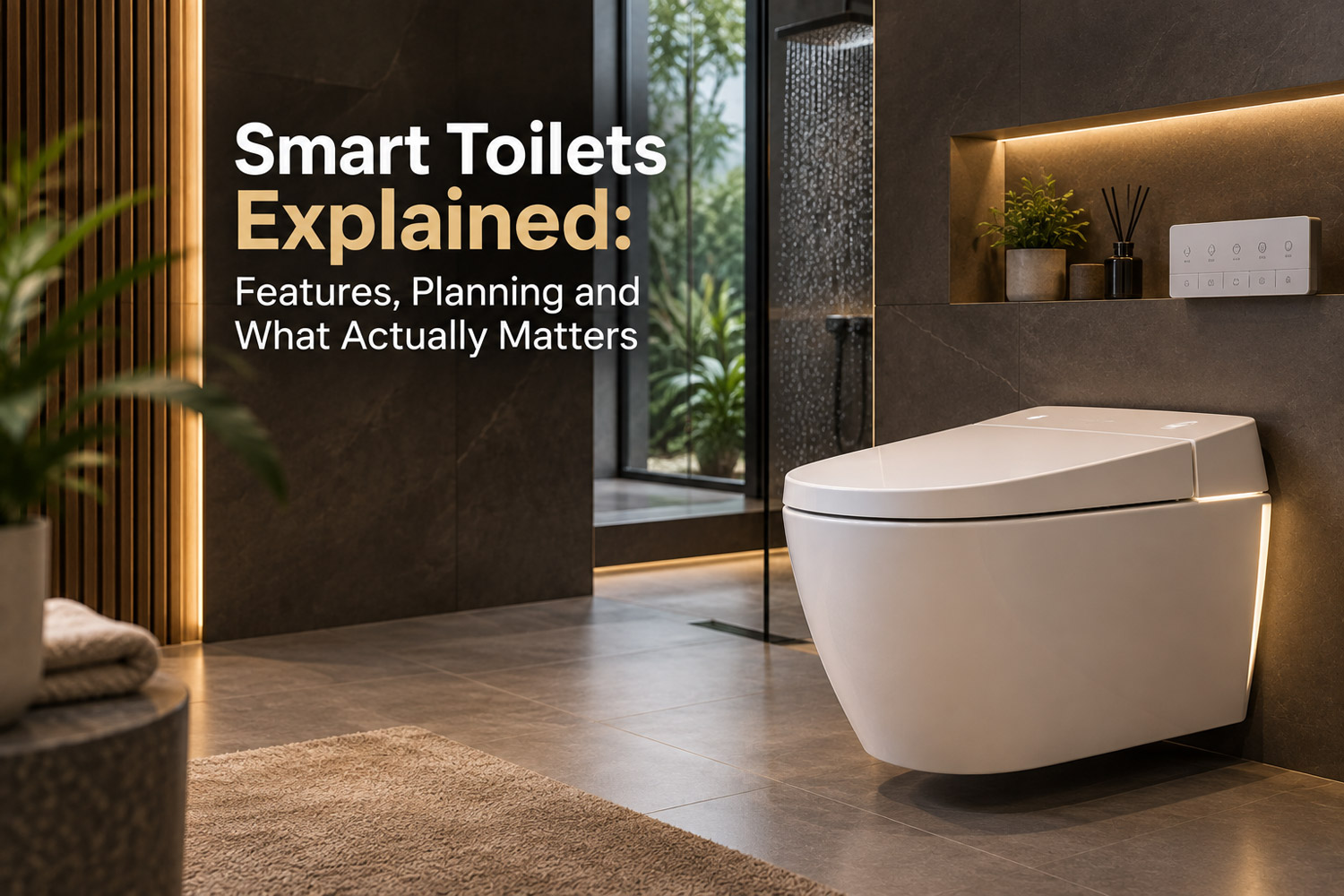
Smart toilets get described as a luxury import — a Japanese indulgence that doesn’t quite belong in Indian bathrooms.
That framing has it backwards.
Indian households already clean with water. The health faucet is standard in nearly every bathroom in the country. A smart toilet isn’t introducing a foreign habit — it’s doing the thing you already do, with warm water, at a controlled pressure, from a nozzle that cleans itself, without you holding anything.
Seen that way, it’s less a luxury than a refinement of something that’s been standard here for generations.
Here’s what these systems actually do, what needs planning before installation, and how to decide whether one belongs in your bathroom.
What a Smart Toilet Actually Does
Features vary by model, but these are the core functions across the category.
Bidet Wash
The central function. A retractable nozzle extends beneath the seat and delivers a directed stream of warm water, then retracts and self-cleans.
What matters here: adjustable water temperature, adjustable pressure, adjustable nozzle position, and separate rear and feminine wash modes. A nozzle that self-sanitises between uses is standard on quality units and worth confirming.
Compared to a health faucet, the difference is control — you’re not managing temperature by feel or aiming by hand.
Heated Seat
Adjustable seat temperature. Less relevant in most of Gujarat than in colder regions, but genuinely appreciated during winter months in northern India and in air-conditioned bathrooms year-round.
Warm Air Dryer
Directed warm air for drying after washing. Adjustable temperature on better units. Reduces paper use substantially, though most users still prefer a final pat dry.
Automatic Lid and Seat
Proximity sensors open the lid as you approach and close it after you leave. Beyond convenience, a closed lid during flushing significantly reduces aerosol spread — a genuine hygiene benefit that’s rarely mentioned.
Sensor Flush
Touchless flushing via sensor or automatic detection. Removes the most-touched surface in the bathroom from the equation entirely.
Deodoriser
Active air filtration through a carbon filter during and after use. More effective than it sounds, and particularly valuable in compact bathrooms or where the toilet is near a bedroom.
Night Light
Soft illumination inside the bowl. Small feature, disproportionately appreciated at 3am.
UV Sterilisation
Some systems include ultraviolet sterilisation of the bowl or nozzle between uses. Available as an integrated function or as a separate sterilising unit.
Explore the full smart toilet range at NEXL.
The Practical Case for Indian Bathrooms
It Replaces the Health Faucet Properly
The health faucet works, but it delivers unheated water at mains pressure, aimed by hand, from a nozzle that sits exposed in the bathroom between uses.
A smart toilet gives you temperature control, pressure control, consistent positioning, and a nozzle that stays enclosed and self-cleans. It’s the same function, substantially better executed.
Hygiene in Multi-User Households
In a bathroom used by several people, the touchless functions matter. No flush lever, no faucet handle, no lid to lift. Combined with a rimless bowl design that has no hidden rim to trap bacteria, the hygiene case becomes substantial.
Accessibility and Ageing in Place
This is the argument that convinces people who dismiss everything else.
For elderly family members, those with limited mobility, or anyone recovering from surgery, the ability to wash and dry without twisting, reaching, or requiring assistance is a meaningful preservation of independence. Families who install smart toilets for this reason rarely describe it as a luxury afterwards.
Water Use
Counterintuitively, a smart toilet often uses less water than the combination of a conventional flush and a health faucet, because the directed wash uses a precise, low volume rather than an open stream.
S-Trap vs P-Trap: Check This First
This is the most important practical detail in the entire purchase, and it’s determined by your existing plumbing — not by preference.
S-trap — the waste outlet exits through the floor. Common in older Indian construction and in most floor-mounted installations.
P-trap — the waste outlet exits through the wall. Standard for wall hung installations and increasingly common in newer construction.
These are not interchangeable. Buying the wrong one means either modifying the waste line — which involves breaking the floor or wall — or returning the unit.
How to check: Look at your existing toilet. If the waste pipe disappears into the floor, you need S-trap. If it runs into the wall behind the pan, you need P-trap.
One more measurement: note the distance from the finished wall to the centre of the waste outlet, called the rough-in. Confirm this matches the model you’re considering before ordering.
Electrical Planning: Decide Before Tiling
This is where smart toilet installations go wrong, and the failure is always the same — deciding too late.
What’s needed: A dedicated power point, typically 15A, positioned near the toilet. For wall hung installations, this usually sits inside or behind the wall cavity, concealed from view.
When it must be decided: Before tiling. Before waterproofing. Ideally at the same time you’re planning the concealed cistern frame position.
What happens if you decide late: Surface-mounted conduit running across finished tiles, or breaking the wall open again. Neither is acceptable in a bathroom you’ve just finished.
Additional considerations:
- The socket must be positioned safely relative to water zones per electrical regulations
- Confirm load requirements — heated seats and dryers draw meaningful current
- A residual current device (RCD) on the circuit is strongly advised
If you are even considering a smart toilet, run the power point. An unused socket inside a wall costs almost nothing. Adding one to a finished bathroom costs a renovation.
Wall Hung or Floor Mounted?
Both formats support smart functions.
Wall hung smart toilets combine the electronic features with a clear floor beneath — easier cleaning, more visual space, and adjustable seat height set at installation. They require a support frame, a concealed cistern, and the electrical point planned into the wall.
Floor mounted smart toilets are simpler to install and better suited to retrofits where opening the wall isn’t practical. The power point still needs planning, but the structural work is minimal.
For a full comparison of the two formats, see our guide to wall hung vs floor mounted toilets.
What to Look For in a Quality Smart Toilet
Self-cleaning nozzle. The nozzle should sanitise itself before and after each use. This is standard on quality units and absent on cheap ones. Ask specifically.
Adjustable everything. Water temperature, water pressure, nozzle position, seat temperature, dryer temperature. Fixed settings suit nobody properly.
Manual flush backup. Confirm the unit flushes without power. Power cuts happen.
Rimless bowl. The electronic features don’t help with bowl hygiene. A rimless washdown design does — no hidden rim, no trapped residue.
Soft-close seat and lid. Should be standard, but verify.
Accessible service points. Filters and nozzles need periodic cleaning. Confirm they’re reachable without dismantling the unit.
Water filter provision. In hard water areas — which includes most of Gujarat — an inline filter significantly extends the life of the nozzle and heating element. Ask whether the model supports one.
Spare parts and service support. Electronic components will eventually need attention. Confirm local service availability before purchase, not after.
Maintenance Expectations
Smart toilets need more attention than conventional ones, though less than people assume.
Regularly: Wipe the seat and lid as normal. Run the nozzle self-clean cycle if it’s manually triggered.
Periodically: Clean or replace the deodoriser filter. Descale the nozzle if you’re in a hard water area without an inline filter.
Annually: Check the water filter, inspect the electrical connection, and confirm all functions operate correctly.
Hard water is the main enemy. Limescale affects nozzles and heating elements more than anything else. An inline filter is a small cost that meaningfully extends service life in Gujarat’s water conditions.
Is a Smart Toilet Right for You?
Strong case if:
- You’re renovating and can plan the electrical point properly
- Elderly or less mobile family members use the bathroom
- Hygiene is a genuine household priority
- You already rely on a health faucet and want better control
- It’s a primary bathroom with daily use
Weaker case if:
- You’re replacing a toilet without renovating
- The bathroom is low-use or for guests
- Local service support is uncertain
- Budget is better spent on shower systems or fittings you use more often
A note on commercial projects: For offices, hotels, and public washrooms, the touchless functions and sensor urinals make a strong hygiene case that’s easier to justify than in residential settings.
Try Before You Decide
Smart toilet specifications communicate features but not experience. Water pressure, nozzle positioning, seat comfort, and control intuitiveness are only assessable in person.
At NEXL’s Experience Center in Ahmedabad, smart toilets are displayed with functions demonstrable — so you can understand how the controls work, see the format options side by side, and discuss the electrical and plumbing requirements before anything is specified.
NEXL Experience Center 111, Sun Orbit, Rajpath Rangoli Road, PRL Colony, SBR, Ahmedabad, Gujarat – 380059
Walk-ins welcome. For renovation projects or trade enquiries, get in touch to arrange a consultation.
Explore online:
Frequently Asked Questions
Q: Can I install a smart toilet in an existing bathroom?
A: Yes, provided you can get power to it. A floor-mounted smart toilet replacing a conventional one is straightforward apart from the electrical point. If running power means breaking finished tiles, weigh whether it’s worth doing outside a renovation.
Q: How much does a smart toilet increase the electricity bill?
A: Very little. The heated seat and dryer draw current only in use, measured in seconds per session. Most units also include an eco mode that reduces standby consumption further.
Q: Is the bidet wash hygienic if multiple people use it?
A: Yes, on quality units. The nozzle retracts into an enclosed housing and sanitises itself between uses. It never contacts the user. Cheaper units may lack self-cleaning — confirm before purchase.
Q: What happens if the electronics fail?
A: The toilet continues functioning as a conventional toilet with manual flush. The electronic module is generally serviceable or replaceable without replacing the entire unit — confirm this for your chosen model.
Q: Do I still need a health faucet?
A: Functionally no, since the smart toilet performs the same task with better control. Many households retain one for general bathroom cleaning, which is a reasonable use.
Q: Are smart toilets suitable for children?
A: Generally yes, though adjust the water pressure to a lower setting. The automatic lid and sensor flush also reduce what children need to touch, which is a practical hygiene benefit in family bathrooms.
A smart toilet isn’t a novelty in an Indian bathroom. It’s a more controlled version of something already standard here.
The decision worth getting right isn’t whether the features appeal — it’s whether you can plan the electrical point and confirm the trap type before installation. Those two details determine whether the purchase works or becomes an expensive complication.
Explore the full smart toilet range at nexl.in/product-category/sanitarywares/smart-toilet/