
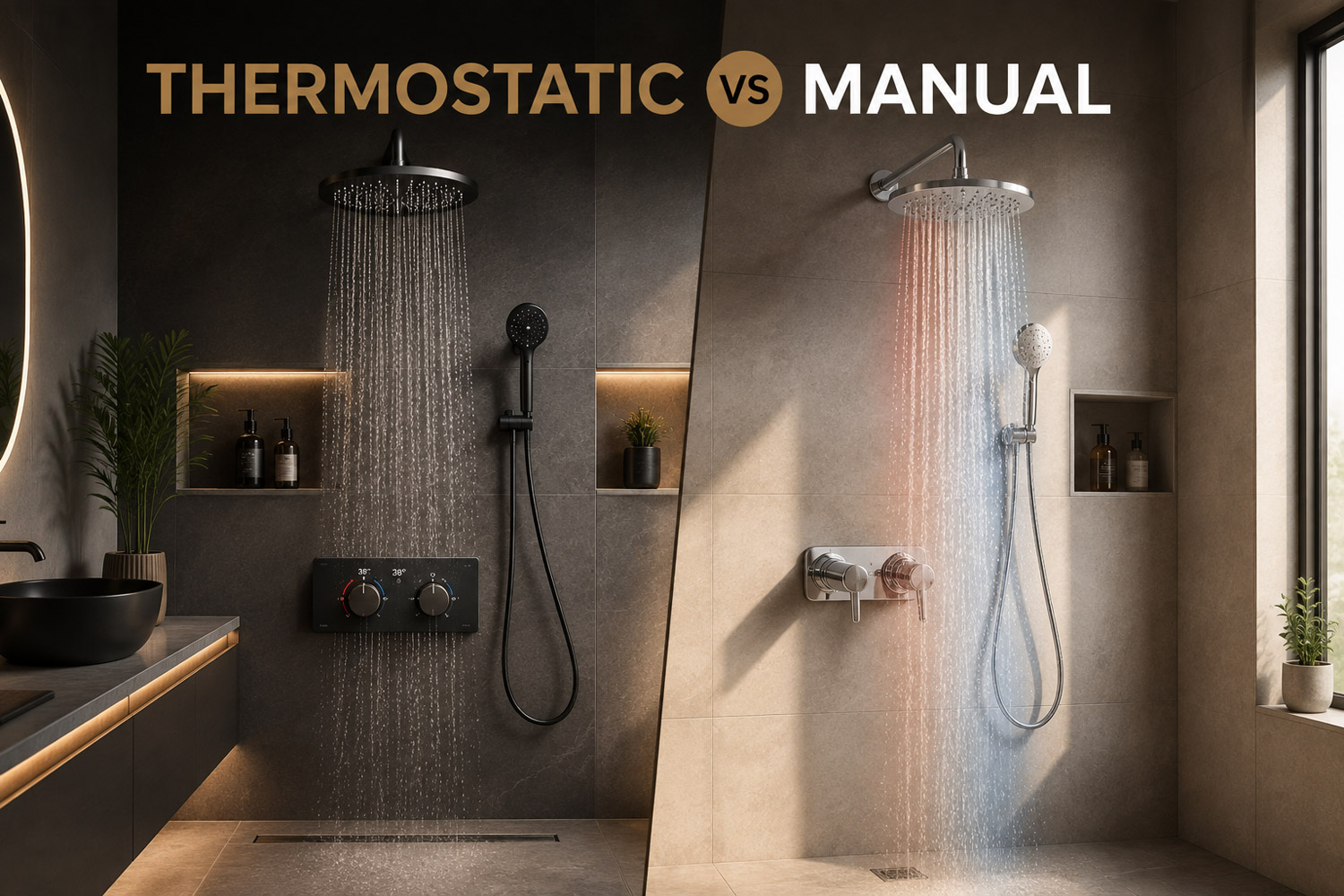
Someone flushes the toilet while you’re in the shower and the water turns scalding. Someone opens a tap in the kitchen and it goes cold. You spend ten seconds every morning adjusting two handles trying to find the temperature you had yesterday.
These are all symptoms of the same thing: a manual shower mixer. And they’re all solved by a thermostatic one.
Yet thermostatic mixers remain poorly understood in Indian bathrooms — often dismissed as a luxury add-on when they’re closer to a safety component. Here’s what actually separates the two, and how to work out which you need.
What is a thermostatic shower mixer?
A thermostatic shower mixer is a valve that automatically maintains your chosen water temperature regardless of pressure changes elsewhere in the plumbing. It uses an internal thermostatic cartridge that adjusts the hot and cold ratio continuously, so the temperature stays constant even if another tap is opened.
What is the difference between a thermostatic and manual shower mixer?
A manual mixer blends hot and cold water in whatever ratio you set the handles to, and that ratio stays fixed — so if incoming pressure changes, your shower temperature changes with it. A thermostatic mixer holds the temperature you selected and adjusts the blend automatically to maintain it.
Are thermostatic shower mixers worth it?
For households with children or elderly members, yes — they prevent sudden scalding, which is a genuine safety benefit rather than a comfort feature. For everyone else, the value is consistency: you set a temperature once and it stays there.
What does “2 way” or “3 way” mean on a shower mixer?
The number refers to how many separate outlets the system can feed — for example a ceiling shower, a hand shower, and body jets. A 3-way thermostatic mixer controls three outlets from one valve, letting you switch between them or run several together.
Do thermostatic showers need high water pressure?
They need adequate and reasonably balanced pressure on both hot and cold supplies to regulate properly. Very low or severely unbalanced pressure limits performance. Confirm your home’s pressure before specifying a multi-outlet system.
How Each One Actually Works
Manual Mixer
You set the handles. The valve blends hot and cold in that fixed proportion and sends it to the outlet.
The critical word is proportion. The valve doesn’t know or care what temperature it’s producing — it only knows the ratio you’ve set. So if cold pressure drops because someone opened a tap elsewhere, the same proportion now contains proportionally more hot water. Your shower gets hotter. Immediately.
Thermostatic Mixer
You set a temperature. Inside the valve, a thermostatic element — typically a wax or bi-metallic cartridge — physically expands and contracts in response to the water temperature passing over it, continuously adjusting the hot and cold inlets to hold your setting steady.
When cold pressure drops, the element reacts within a fraction of a second and reduces hot flow to compensate. The temperature at the showerhead barely moves.
Most quality thermostatic valves also include an anti-scald safety stop — if the cold supply fails entirely, the valve shuts off rather than delivering pure hot water.
Side-by-Side Comparison
| Factor | Thermostatic | Manual |
|---|---|---|
| Temperature stability | Holds steady automatically | Varies with pressure |
| Scald protection | Built-in safety cutoff | None |
| Setting temperature | Set once, returns to it | Re-adjust each time |
| Cost | Higher | Lower |
| Internal complexity | Thermostatic cartridge | Simple mixing valve |
| Multi-outlet capability | Common (2–5 way) | Usually single outlet |
| Best for | Families, multi-outlet showers | Simple single-shower setups |
| Pressure requirement | Needs balanced supply | More tolerant |
Why Thermostatic Matters More in Indian Homes
Three conditions common in Indian plumbing make thermostatic control genuinely useful rather than merely nice:
Shared supply lines. In most apartments, bathrooms share pressure with kitchens and other bathrooms. Any tap opening anywhere shifts your shower temperature. Thermostatic control absorbs that.
Geyser temperature spikes. Storage water heaters don’t deliver perfectly consistent output temperature. A manual mixer passes that variation straight through to you. A thermostatic valve filters it out.
Multi-generational households. Children and elderly family members have thinner skin and slower reaction times. Scalding happens faster and does more damage. The anti-scald cutoff on a thermostatic valve is the single strongest argument for the format.
If your household includes young children or elderly members, this stops being a comfort discussion and becomes a safety one.
Understanding “Ways”: 2, 3, 4 and 5 Way Systems
This is where most buyers get lost, and it’s genuinely the most confusing part of specifying a shower.
“Ways” means outlets. A 3-way thermostatic mixer can feed three separate water outputs from a single valve.
What Each Configuration Typically Covers
2-Way — Ceiling or wall shower + hand shower The most common setup. Covers everyday use plus a handheld for rinsing and cleaning.
3-Way — Ceiling shower + hand shower + one additional outlet The third outlet is usually body jets or a bath spout. This is the sweet spot for most premium residential bathrooms.
4-Way — Adds a second additional outlet Typically ceiling shower, wall shower, hand shower, and body jets. Suits larger bathrooms with a defined shower zone.
5-Way — Full multi-outlet spa configuration Ceiling shower, wall shower, hand shower, body jets, and bath spout. Requires strong, well-balanced pressure to run properly.
How to Choose Your Configuration
Count your actual outlets before anything else. Walk through how you’d use the shower on a normal day, then on a day when you want more.
Be realistic. A 5-way system in a bathroom with modest water pressure will underperform on every outlet simultaneously. It’s better to have a 3-way system that works excellently than a 5-way that works adequately.
Browse the full thermostatic range at NEXL to see configurations from 2-way through 5-way, including both exposed mixers and in-wall body systems.
Concealed vs Exposed Thermostatic Systems
Concealed (In-Wall)
The valve body is embedded in the wall. Only the control handles and outlets are visible.
Advantages: Minimal visual profile, nothing to clean around, coordinates cleanly with wall-hung sanitaryware and modern tiling.
Considerations: Must be planned before tiling. The rough-in position and depth are fixed once the wall closes. Servicing is done through the trim plate, so choose a system designed for that.
Exposed
The valve and pipework are visible on the wall surface.
Advantages: Far easier retrofit, fully accessible for maintenance, no wall work required.
Considerations: More visual clutter, more surfaces to clean around.
The practical rule: if you’re renovating and tiling anyway, concealed is worth doing. If you’re upgrading an existing bathroom without touching walls, exposed is the sensible choice.
Explore in-wall thermostatic body systems and exposed thermostatic mixers to compare both formats.
Water Pressure: The Step Everyone Skips
A thermostatic mixer regulates by adjusting the balance between hot and cold. That means it needs both supplies to have workable, reasonably similar pressure.
Before you specify anything, check:
Is hot and cold pressure roughly balanced? Severely unbalanced supply is the most common cause of disappointing thermostatic performance. A pressure-balancing valve or matched supply lines usually solves it.
Is there enough total flow for your outlet count? Running a ceiling shower and four body jets simultaneously needs substantially more flow than a single showerhead. If your supply can’t deliver it, every outlet runs weak.
Where is the geyser, and how big is it? A small storage heater will run out mid-shower on a multi-outlet system regardless of how good the valve is.
Any supplier recommending a 5-way system without asking about your water pressure isn’t specifying — they’re selling. This is the question that should come first.
What to Look For in a Quality Thermostatic Mixer
Solid brass body. Same principle as any premium fitting — brass resists corrosion and handles thermal cycling. This is covered in more depth in our guide to choosing premium bathroom fittings.
Reliable thermostatic cartridge. This is the component doing the actual work. Ask about the cartridge type, expected lifespan, and — critically — spare part availability.
Anti-scald safety stop. Should shut off if cold supply fails. Non-negotiable in a household with children.
Temperature limit setting. Many quality valves let you cap the maximum temperature during installation. Worth setting for family bathrooms.
Serviceable trim. For concealed systems, confirm the cartridge can be replaced through the wall plate without breaking tiles.
Finish consistency. Your shower controls should match your basin mixers and accessories. Decide the finish across all of them together.
When a Manual Mixer Is the Right Call
Thermostatic isn’t automatically correct. Manual makes sense when:
- It’s a single-outlet shower with no additional jets or spouts
- The bathroom is used by adults only
- Water supply is stable and unshared
- Budget is better allocated to other fittings
- It’s a guest bathroom with occasional use
There’s no virtue in over-specifying a bathroom that gets used twice a month.
Common Mistakes
Specifying more ways than your pressure supports. The most frequent and most disappointing error. Check pressure first, then choose configuration.
Deciding concealed vs exposed after tiling starts. Concealed systems need rough-in position fixed before the wall closes.
Forgetting the geyser capacity. A multi-outlet system draws far more hot water than a single shower. Size the heater accordingly.
Mismatched finishes. Shower controls, showerheads, basin mixers, and accessories should share one finish family.
Ignoring cartridge serviceability. A concealed valve you can’t service without demolition is a future problem you’re building into your wall.
See the Systems in Person
Water pressure, flow feel, and control smoothness aren’t communicable through specifications. Neither is the difference between a 3-way and 5-way system in a real bathroom.
At NEXL’s Experience Center in Ahmedabad, thermostatic systems are displayed alongside coordinating showers and fittings — so you can see configurations in context and get guidance from a team that will ask about your water pressure before recommending anything.
NEXL Experience Center 111, Sun Orbit, Rajpath Rangoli Road, PRL Colony, SBR, Ahmedabad, Gujarat – 380059
Walk-ins welcome. For renovation projects or trade enquiries, get in touch to arrange a consultation.
Explore online:
Frequently Asked Questions
Q: Can I retrofit a thermostatic mixer into an existing shower? A: Yes, with an exposed thermostatic mixer — it replaces your existing valve without wall work. A concealed system requires opening the wall and is best done as part of a renovation.
Q: How long does a thermostatic cartridge last? A: In a quality valve with reasonable water conditions, typically 8–12 years. Hard water shortens this. Confirm replacement cartridges are available for the model you choose.
Q: Will a thermostatic mixer work with an instant water heater? A: It can, but instant heaters vary output temperature with flow rate, which makes regulation harder. Storage heaters generally pair better with thermostatic systems, particularly multi-outlet ones.
Q: Does a thermostatic mixer waste water? A: The opposite. Because it holds temperature accurately, you spend less time running water while adjusting — and you don’t have to re-find your setting each time.
Q: Can I run all outlets on a 5-way system at once? A: Only if your supply delivers enough flow. Many multi-way systems are designed for switching between outlets rather than running all simultaneously. Confirm the intended operation before purchase.
Q: Is a thermostatic mixer necessary if I live alone? A: Not necessary, but still pleasant. The main safety argument weakens without children or elderly users, though the consistency benefit remains.
The difference between a thermostatic and manual shower mixer isn’t really about luxury. It’s about whether your shower responds to what’s happening elsewhere in your plumbing, or ignores it.
For most modern bathrooms — particularly those with multiple outlets or a household that includes children — thermostatic control is the format that makes the rest of the shower system work as intended.
Explore the full thermostatic range at nexl.in/product-category/thermostats/