
Of all the decisions in a bathroom renovation, this one has the longest consequences. Tiles can be changed. Fittings can be swapped. But the choice between a wall hung and a floor mounted toilet gets built into the wall and the floor — and reversing it later means demolition.
It’s also the decision people research least. Most homeowners pick whatever their plumber suggests, or whatever matches the existing waste outlet, and never learn what the alternative would have offered.
Here’s the full comparison, including the parts that don’t usually make it into showroom conversations.
What is the difference between a wall hung and floor mounted toilet?
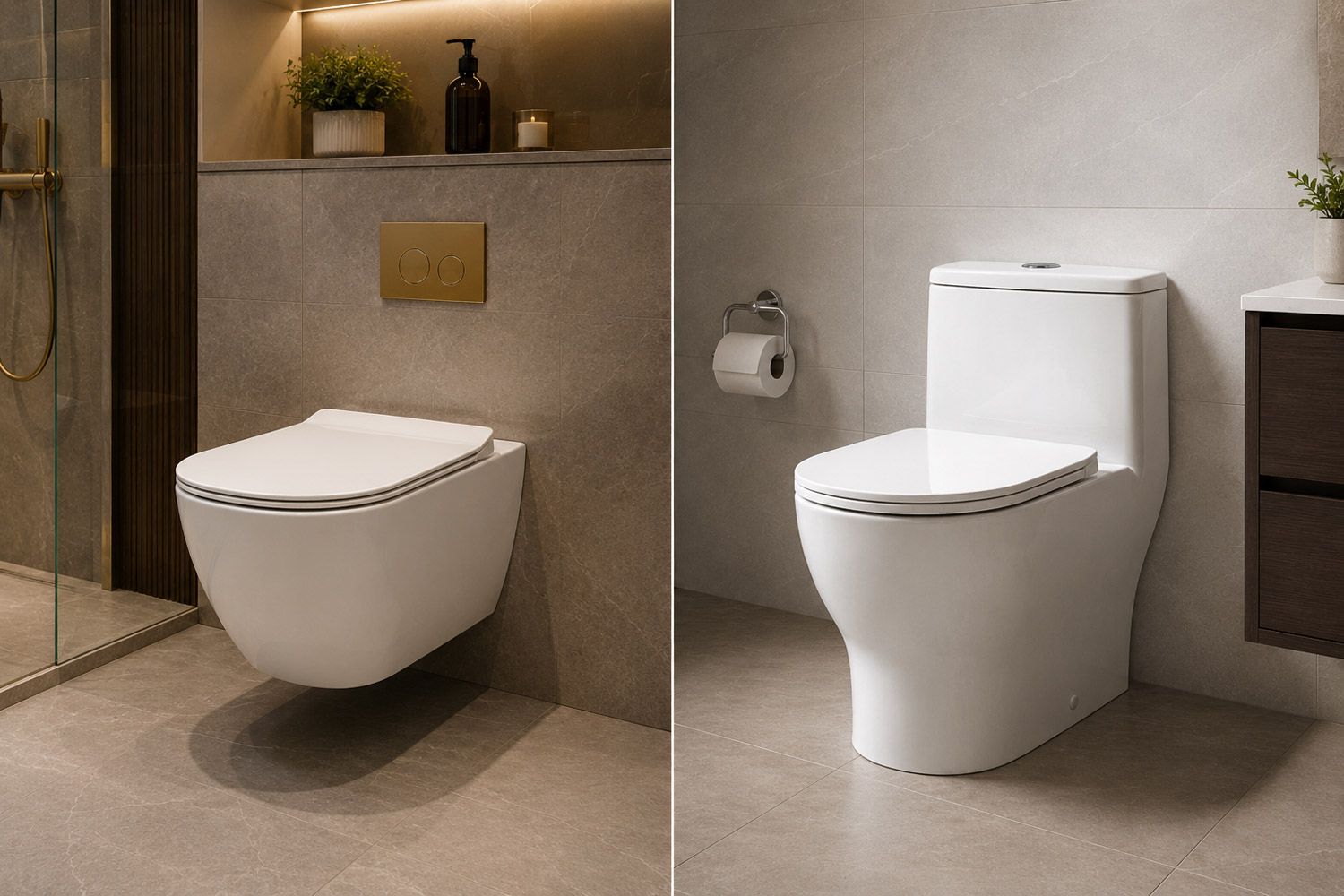
A wall hung toilet mounts to a metal frame inside the wall with the cistern concealed behind it, leaving the floor completely clear beneath the pan. A floor mounted toilet rests directly on the floor with the cistern visible, either close-coupled to the pan or mounted on the wall above it.
Is a wall hung toilet better than a floor mounted one?
For most modern bathrooms, yes. Wall hung toilets are easier to clean beneath, save visual space, and allow height adjustment during installation. Floor mounted toilets are cheaper, simpler to install, and better suited to renovations where opening the wall isn’t practical.
Can a wall hung toilet hold an adult’s weight?
Yes. A properly installed wall hung toilet uses a steel support frame anchored to the floor and wall, rated to hold 400 kg or more. The weight is carried by the frame, not the wall surface. Failures are almost always installation errors, not design limits.
Are wall hung toilets harder to repair?
Not significantly. Modern concealed cisterns are serviced through the flush plate opening — the plate lifts out and gives access to the fill valve and flush mechanism. No tile-breaking required for routine maintenance.
Do wall hung toilets cost more?
Yes, typically. The pan itself may be similarly priced, but you also need a concealed cistern and support frame, plus more installation labour. Expect the total wall hung installation to cost meaningfully more than an equivalent floor mounted setup.
The Core Difference
Floor mounted toilets sit on the floor. The cistern is visible — either directly attached to the pan (close-coupled) or mounted separately on the wall above. Everything is exposed and accessible.
Wall hung toilets appear to float. The pan is bolted to a steel frame hidden inside the wall, and the cistern sits concealed behind the tiles. All you see is the pan and a flush plate.
That single structural difference drives everything else — cost, cleaning, space, installation, and repair.
Wall Hung vs Floor Mounted: Full Comparison
| Factor | Wall Hung | Floor Mounted |
|---|---|---|
| Floor cleaning | Fully clear — mop straight under | Must clean around the base |
| Visual space | Makes rooms feel larger | Takes up visible floor volume |
| Height adjustment | Set at installation to suit users | Fixed by manufacture |
| Installation cost | Higher — frame, cistern, labour | Lower — simpler process |
| Installation complexity | Requires wall cavity work | Straightforward |
| Renovation suitability | Best planned from the start | Easy retrofit |
| Cistern access | Via flush plate | Fully exposed |
| Weight capacity | 400 kg+ with correct frame | Floor-supported |
| Noise | Concealed cistern is quieter | More audible refill |
| Aesthetic | Minimal, contemporary | Traditional to transitional |
The Case for Wall Hung Toilets
1. Cleaning Is Genuinely Easier
This is the practical benefit people notice most after installation.
A floor mounted toilet has a base that meets the floor, and that junction collects dust, moisture, and residue. It needs cleaning around, into, and behind — awkwardly, and often incompletely.
A wall hung toilet leaves the floor entirely open. You mop straight underneath in one pass. No pedestal, no seam, no trapped grime line.
Combine this with a rimless washdown design — which removes the hidden inner rim inside the bowl — and you eliminate both of the hardest-to-clean areas of a conventional toilet at once. We covered the bowl side of this in detail in our guide to rimless washdown toilets.
2. Small Bathrooms Feel Larger
Visible floor is the single strongest cue the human eye uses to judge room size. When the floor runs uninterrupted from wall to wall, a compact bathroom reads as noticeably more open.
This is why wall hung sanitaryware has become standard in premium apartment design, where bathroom footprints are tight and every visual trick counts. Pairing a wall hung toilet with a wall hung basin compounds the effect considerably.
3. You Can Set the Height
This is underrated and rarely mentioned in showrooms.
A floor mounted toilet is whatever height the manufacturer made it. A wall hung toilet is mounted at whatever height you specify during installation.
Standard is around 400–420mm from finished floor to seat top. But you can raise it for taller users or for elderly family members who find standing from a low seat difficult. That’s meaningful accessibility planning — and it costs nothing extra if decided before installation.
4. Quieter Operation
Concealed cisterns sit inside an insulated wall cavity. The refill sound after flushing is noticeably muffled compared to an exposed cistern. In apartments where the bathroom shares a wall with a bedroom, this matters more than people expect.
5. Cleaner Visual Language
A wall hung toilet presents as a single simple form. No visible tank, no pipework, no pedestal — just the pan and a flat flush plate.
For contemporary and minimal bathroom schemes, this is often the difference between a design that resolves and one that almost does.
The Case for Floor Mounted Toilets
Wall hung isn’t automatically the right answer. There are real situations where floor mounted is the better call.
1. Significantly Lower Total Cost
A wall hung installation needs three things: the pan, a concealed cistern, and a support frame. Plus additional labour for the wall cavity work.
A floor mounted close-coupled toilet needs the unit and a few hours of standard plumbing.
If budget is the binding constraint, that difference is better spent on a quality shower system or basin mixer — fittings you interact with far more often during a typical day.
2. Much Simpler Retrofit
If you’re replacing a toilet in an existing bathroom without touching tiles, floor mounted is dramatically easier. The waste outlet is usually already positioned for it, and no wall needs opening.
Converting an existing bathroom from floor mounted to wall hung means breaking tiles, building a cavity or false wall, and relocating the waste connection. That’s a renovation, not a replacement.
3. Structural Constraints
Wall hung frames need something solid to anchor into. Most modern construction handles this without issue, but very thin partition walls, certain drywall configurations, or older buildings may need additional structural work first.
An honest supplier will raise this before you commit. If nobody has asked about your wall construction, ask them.
4. Familiar Servicing
Everything on a floor mounted toilet is visible and reachable. For households that prefer complete accessibility over concealed elegance, that’s a legitimate preference — not a compromise.
Understanding Concealed Cisterns
If you’re going wall hung, the concealed cistern is half the purchase — and it’s where quality differences are least visible but most consequential.
Why it matters: The cistern lives inside your wall for the life of the bathroom. A cheap one that fails prematurely is a genuinely expensive problem to solve.
What to look for:
- Serviceable through the flush plate — the fill valve and flush mechanism should be removable without touching tiles
- Dual flush — separate full and reduced volumes for water efficiency
- Robust support frame — steel, adjustable, rated for 400 kg or more
- Spare parts availability — confirm the manufacturer supports the model long-term
Flush plates are the only visible part of the system, so they should coordinate with your other fittings. If your faucets are matte black, the flush plate should be too. This is a small detail that gets forgotten and then looks obviously wrong.
Explore the full sanitaryware range including concealed cistern options at NEXL.
What About Smart Toilets?
Both formats support integrated smart functions — heated seats, bidet washing, warm air drying, automatic lids, and sensor flushing.
Wall hung smart toilets combine the cleaning and space advantages of the format with those features, though they require a power supply planned into the wall during installation. That’s straightforward when decided early and disruptive when decided late.
If you’re considering it, browse the smart toilet range and plan the electrical point before tiling begins.
How to Decide: A Simple Framework
Choose wall hung if:
- You’re doing a full bathroom renovation, not a swap
- The bathroom is compact and you want it to feel larger
- Cleaning ease is a real priority for your household
- You want to set seat height for specific users
- The design direction is contemporary or minimal
Choose floor mounted if:
- You’re replacing a toilet without renovating
- Budget is tight and better spent elsewhere
- Wall structure is uncertain or problematic
- You prefer fully accessible components
The honest summary: if you’re renovating anyway, wall hung is worth the additional cost for most households — the cleaning and space benefits compound daily over years. If you’re not renovating, forcing a wall hung conversion is rarely worth the disruption.
Common Mistakes to Avoid
Deciding after the plumbing is roughed in. Wall hung requires the waste outlet at a specific height inside the wall. Decide before rough-in, not after.
Buying the pan and cistern separately without checking compatibility. Not every pan fits every frame. Confirm the pairing.
Choosing the flush plate last. It’s the only visible part of the concealed system and should match your other fittings — decide it alongside them, not as an afterthought.
Skipping the wall structure check. Ask about your wall construction before committing to wall hung. A good supplier raises this unprompted.
Ignoring seat height. You get one chance to set it. Think about who uses this bathroom now, and who might in ten years.
See Both Formats in Person
Specifications tell you what a toilet does. They don’t tell you how it looks in a room, how the proportions read, or whether the flush plate finish matches the faucet you’ve already chosen.
At NEXL’s Experience Center in Ahmedabad, wall hung and floor mounted options are displayed in realistic settings alongside coordinating fittings — so you can see both formats in context and compare them properly before committing to something that gets built into your wall.
NEXL Experience Center 111, Sun Orbit, Rajpath Rangoli Road, PRL Colony, SBR, Ahmedabad, Gujarat – 380059
Walk-ins welcome. For renovation projects or trade enquiries, get in touch to arrange a consultation.
Explore online:
Frequently Asked Questions
Q: Can I convert my existing floor mounted toilet to wall hung? A: Technically yes, but it’s a renovation rather than a replacement. You’ll need to open the wall, install a support frame and concealed cistern, and relocate the waste connection. It’s worth doing as part of a full bathroom renovation, rarely worth it on its own.
Q: How much space does a concealed cistern need behind the wall? A: Typically 150–200mm of cavity depth. In bathrooms without existing cavity space, this is usually achieved by building a false wall — which also creates a useful ledge above for storage.
Q: What happens if the concealed cistern leaks? A: Quality cisterns are designed to be serviced through the flush plate opening, so most repairs don’t require breaking tiles. This is precisely why cistern quality matters more than its invisibility suggests — cheap components create expensive problems.
Q: Is a wall hung toilet suitable for elderly users? A: It can be excellent, because seat height is adjustable at installation. Set it slightly higher than standard and standing becomes noticeably easier. Plan grab bar positioning at the same time.
Q: Does a wall hung toilet flush as effectively as a floor mounted one? A: Yes. Flush performance depends on bowl design and cistern volume, not mounting format. A rimless washdown wall hung toilet typically outperforms a conventional rimmed floor mounted unit on both coverage and hygiene.
Q: Which format is better for a small bathroom? A: Wall hung, clearly. The uninterrupted floor makes compact bathrooms read as significantly larger, and the clear space underneath makes a small room easier to keep clean.
The toilet is the least discussed and most used fixture in any bathroom. Choosing between wall hung and floor mounted isn’t about which is objectively superior — it’s about matching the format to your renovation scope, your budget, and how your household actually lives.
Get it right at the planning stage, and it’s a decision you’ll never think about again. Which, for a toilet, is exactly the goal.
Explore the full sanitaryware range at nexl.in/product-category/sanitarywares/