
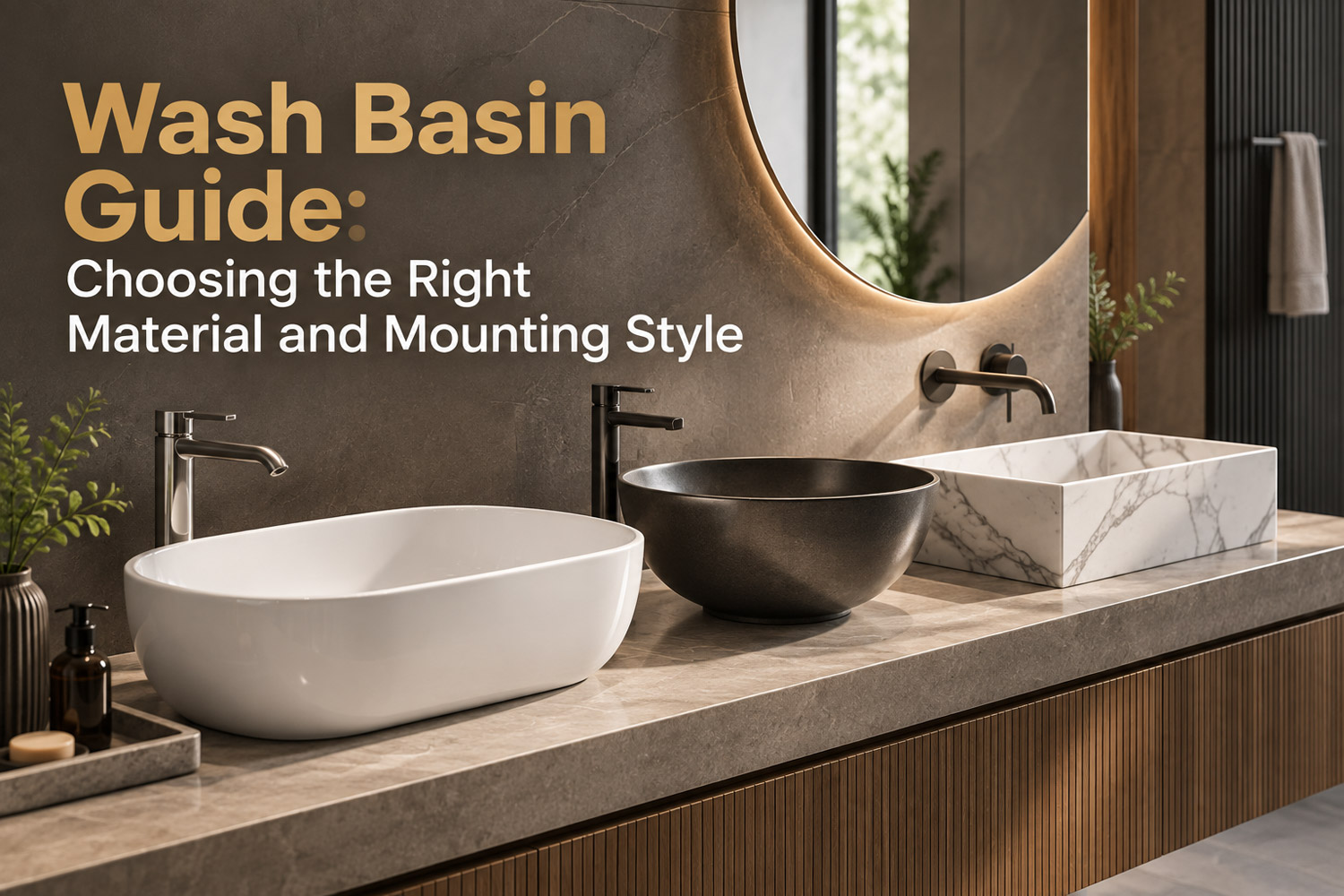
The basin is the fixture you look at most and think about least.
It’s directly in your eyeline every morning. It’s the first thing a guest notices. And unlike a toilet or a shower, it’s almost entirely a visual decision — which is exactly why so many people choose one from a photograph and then discover, months later, that it chips easily, shows every water mark, or sits at completely the wrong height for the faucet they bought separately.
There are two decisions here, and they’re independent of each other: what it’s made of, and how it mounts. Getting both right is what separates a basin that ages well from one you quietly resent.
Part 1: Materials
Ceramic — The Default, For Good Reason
Ceramic (including vitreous china and fine fire clay) is what most basins are made of, and it earns that position.
Strengths: The glazed surface is non-porous, so it doesn’t absorb stains or odours. It wipes clean easily, resists most household chemicals, and handles daily use for decades without visible deterioration. It’s also the most versatile in manufacture, which is why ceramic offers the widest range of shapes — round, oval, rectangular, platform, wall hung, and freestanding.
Weaknesses: It can chip if something heavy is dropped on it, and a chip in ceramic is difficult to repair invisibly. It’s also heavier than alternatives, which matters for wall hung installations.
Best for: Almost any bathroom. If you’re unsure, ceramic is the safe choice — and “safe” here means it will still look right in ten years.
Design range: Ceramic is also where the most decorative options live — Moroccan patterns, black and gold detailing, hand-finished artistic pieces. If you want the basin to be the statement in the room, ceramic gives you the most choices.
Stainless Steel — Durable and Underrated
Stainless steel basins are often associated with commercial washrooms, which undersells them considerably for residential use.
Strengths: Essentially unbreakable. No chipping, no cracking, no staining. Naturally hygienic and resistant to bacteria. Significantly lighter than ceramic, which makes wall hung installation simpler. Modern finishes — brushed, satin, matte black, gold PVD — look far more refined than the utilitarian steel most people picture.
Weaknesses: Shows water spots and fingerprints more readily than ceramic, particularly in polished finishes. Can be noisier when water hits it directly. Scratches over time, though brushed finishes hide this well.
Best for: High-traffic family bathrooms, commercial projects, and contemporary schemes where a metal finish coordinates with the fittings. Also excellent where weight is a constraint.
Glass — Maximum Impact, Maximum Maintenance
Glass basins — fluted, crystal, transparent, or coloured — are unambiguously a design statement.
Strengths: Visually striking in a way no other material matches. Fluted and textured glass catches light beautifully and adds genuine character to a bathroom. Transparent designs create a sense of lightness in compact spaces. Easy to clean in the sense that nothing stains it.
Weaknesses: Shows everything. Every water droplet, every soap mark, every fingerprint is visible. In hard water areas — which includes most of Gujarat — limescale spotting requires frequent wiping to stay looking good. Tempered glass is strong but not unbreakable.
Best for: Guest bathrooms, powder rooms, and primary bathrooms where the owner genuinely enjoys maintaining them. Be honest with yourself here — a glass basin in a busy family bathroom will look neglected within a week.
A practical note: Fluted and textured glass hides water marks noticeably better than flat transparent glass. If you want the look with less maintenance, textured is the sensible compromise.
Solid Surface — Sculptural Freedom
Solid surface materials (including transparent and resin composites) allow forms that are impossible to produce in ceramic.
Strengths: Seamless, sculptural shapes. Warm to the touch, unlike ceramic or steel. Non-porous and hygienic. Minor scratches can often be buffed out — a genuine advantage no other material offers. Transparent variants create striking visual effects.
Weaknesses: Generally the highest cost. More vulnerable to heat damage than ceramic. Fewer shape options than ceramic overall, despite the greater freedom in the shapes that do exist.
Best for: Design-led bathrooms where the basin is meant to be the architectural moment, and freestanding installations where the form is visible from all sides.
Material Comparison
| Material | Durability | Cleaning | Water Marks | Weight | Best For |
|---|---|---|---|---|---|
| Ceramic | Excellent (can chip) | Easiest | Minimal | Heavy | Any bathroom |
| Stainless Steel | Exceptional | Easy | Shows readily | Light | High-use, family |
| Glass | Good (tempered) | Easy but frequent | Shows everything | Medium | Statement, low-use |
| Solid Surface | Very good | Easy | Minimal | Light–medium | Design-led, freestanding |
Browse the full basins and bathtubs range at NEXL to compare materials across formats.
Part 2: Mounting Styles
Material determines how a basin looks and behaves. Mounting determines how it works in the room.
Table Top / Vessel
Sits entirely above the counter. The most popular contemporary format, and the most visually prominent.
Advantages: Strong design presence. The counter below stays fully usable. Easy to replace later without touching plumbing or counter.
Considerations: Requires a tall or wall-mounted faucet. Total height needs planning — a deep vessel on a standard counter sits uncomfortably high. Water can splash onto the counter around the base.
Height rule: Counter height plus basin depth should land around 800–850mm total. If the basin is 150mm deep, the counter needs to sit lower than standard.
Wall Hung
Mounted directly to the wall with no pedestal or counter beneath.
Advantages: Clear floor beneath makes compact bathrooms feel significantly larger — the same principle that makes wall hung toilets work so well in small spaces. Easy to mop under. Height can be set during installation to suit users.
Considerations: Needs adequate wall structure for support. Exposed plumbing beneath unless a bottle trap in a matching finish is specified — which should be planned, not discovered afterwards.
Pairing note: A wall hung basin with a wall hung toilet is the strongest combination for making a small bathroom feel open. If space is your primary constraint, this is the answer.
Pedestal
Basin supported by a floor-standing column that conceals the plumbing.
Advantages: Hides pipework completely with no cabinetry required. Traditional and transitional appeal. Structurally straightforward — no wall reinforcement needed.
Considerations: No storage beneath. Takes visible floor space. Cleaning around the pedestal base is less convenient than a wall hung alternative.
Freestanding
A full-height sculptural basin standing independently on the floor.
Advantages: The strongest statement available in a bathroom. Visible from all sides. No counter or cabinetry required.
Considerations: Needs space around it to be appreciated — cramming one into a tight bathroom defeats the purpose. Floor plumbing must be positioned precisely, so this is a decision made at rough-in stage. Generally the highest cost.
Best for: Large primary bathrooms and powder rooms where the basin is meant to be the focal point.
Platform / Semi-Recessed
Partially recessed into the counter, with part of the bowl projecting forward.
Advantages: Lower overall height than a full vessel. Some design presence without full vessel prominence. Works well on narrower counters.
Part 3: The Faucet Pairing Everyone Gets Wrong
This is the single most common basin mistake, and it happens because the basin and faucet are usually chosen at different times.
The problem: A table top basin raises the water surface by 100–200mm. A standard basin faucet is designed for a counter-recessed basin. Put them together and the spout sits barely above the rim — not enough clearance to comfortably get your hands underneath.
The fix — three options:
Tall basin faucet. Purpose-built for vessel basins with additional spout height. The most common solution.
Wall-mounted faucet. Mounted above the basin on the wall. Cleanest appearance and keeps the counter completely clear — but the rough-in position must be fixed before tiling, and it must be correct for your specific basin depth.
Lower the counter. Works if the basin is going onto custom cabinetry. Less practical with existing units.
Also check spout reach. The water should land near the centre of the bowl, not against the back wall or over the front rim. Reach matters as much as height, and it’s checked less often.
Browse basin faucets and mixers at NEXL, where tall and wall-mounted options are specified alongside compatible basins. For more on what separates quality fittings, see our guide to choosing premium bathroom fittings.
Practical Checks Before You Buy
Measure the counter or wall space. Basins are larger in reality than they appear in photographs. Confirm the footprint, not just the bowl size.
Check bowl depth. Shallow bowls splash. Anything under about 100mm of internal depth will throw water onto the counter and your clothes.
Confirm the waste and trap. Pop-up waste and bottle trap should match your basin’s fitting type and your chosen finish. Exposed traps under wall hung basins are visible — specify them in the same finish as your faucet.
Consider overflow. Some designer basins have no overflow hole, which means they need a matching waste designed for that configuration. Mismatching these causes drainage problems.
Think about hard water. In Ahmedabad’s water conditions, matte and textured surfaces show limescale less than polished ones. Worth weighing if maintenance frequency matters to you.
Matching Basin to Bathroom Type
Compact bathroom: Wall hung ceramic or stainless steel. Clear floor beneath does more for perceived space than any other choice.
Family bathroom: Ceramic or stainless steel, table top or counter-mounted. Prioritise durability and easy cleaning over statement design.
Powder room / guest bathroom: This is where glass and decorative ceramic earn their place. Low use means high maintenance is manageable, and impact per visitor is highest.
Large primary bathroom: Freestanding or solid surface, where there’s room for the form to be seen properly.
Commercial washroom: Stainless steel, wall hung. Effectively indestructible and straightforward to maintain.
See Basins in Person — This One Matters More Than Most
Basin material is difficult to judge from photographs in a way that faucets and sanitaryware aren’t.
Ceramic glaze varies in warmth. Stainless steel finishes look different under bathroom lighting than under showroom spots. Fluted glass has a depth and light behaviour that no photograph captures. And proportions — how large a basin actually reads in a room — are almost impossible to judge on a screen.
At NEXL’s Experience Center in Ahmedabad, basins are displayed across all four materials in realistic settings, with compatible faucets shown alongside so you can check height clearance before committing.
NEXL Experience Center 111, Sun Orbit, Rajpath Rangoli Road, PRL Colony, SBR, Ahmedabad, Gujarat – 380059
Walk-ins welcome. For renovation projects or trade enquiries, get in touch to arrange a consultation.
Explore online:
Frequently Asked Questions
Q: Can a chipped ceramic basin be repaired?
A: Small chips can be filled with ceramic repair compound, but the repair is usually visible under close inspection. Prevention matters more — avoid storing heavy items on shelves above the basin.
Q: Do glass wash basins break easily?
A: Quality glass basins are tempered, which makes them considerably stronger than ordinary glass and far more resistant to thermal shock. They’re not fragile in normal use. The practical concern is water marks, not breakage.
Q: What size wash basin do I need?
A: For a single-user bathroom, 450–550mm width is typical. Shared or family bathrooms benefit from 600mm or wider. Always confirm the footprint fits your counter with usable space remaining on either side.
Q: Are stainless steel basins noisy?
A: They can be, particularly when water hits the bowl directly. Quality basins include sound-dampening material underneath. Positioning the faucet so water lands at an angle rather than straight down also reduces it noticeably.
Q: Should the basin match the toilet?
A: They should coordinate rather than match exactly. Same colour family and compatible design language is enough — many well-designed bathrooms pair a ceramic toilet with a glass or steel basin deliberately.
Q: Which basin is best for hard water areas?
A: Ceramic with a quality glaze resists limescale best. Among alternatives, matte and textured finishes hide spotting far better than polished ones. Avoid flat transparent glass if low maintenance is a priority.
The basin is the fixture your bathroom gets judged on. It’s also the one where material and mounting choices interact with faucet height, counter depth, and plumbing position in ways that are difficult to correct afterwards.
Decide the material for how you’ll maintain it. Decide the mounting for how the room needs to work. And choose the faucet at the same time, not after.
Explore the full basins range at nexl.in/product-category/bathtubs-basins/