
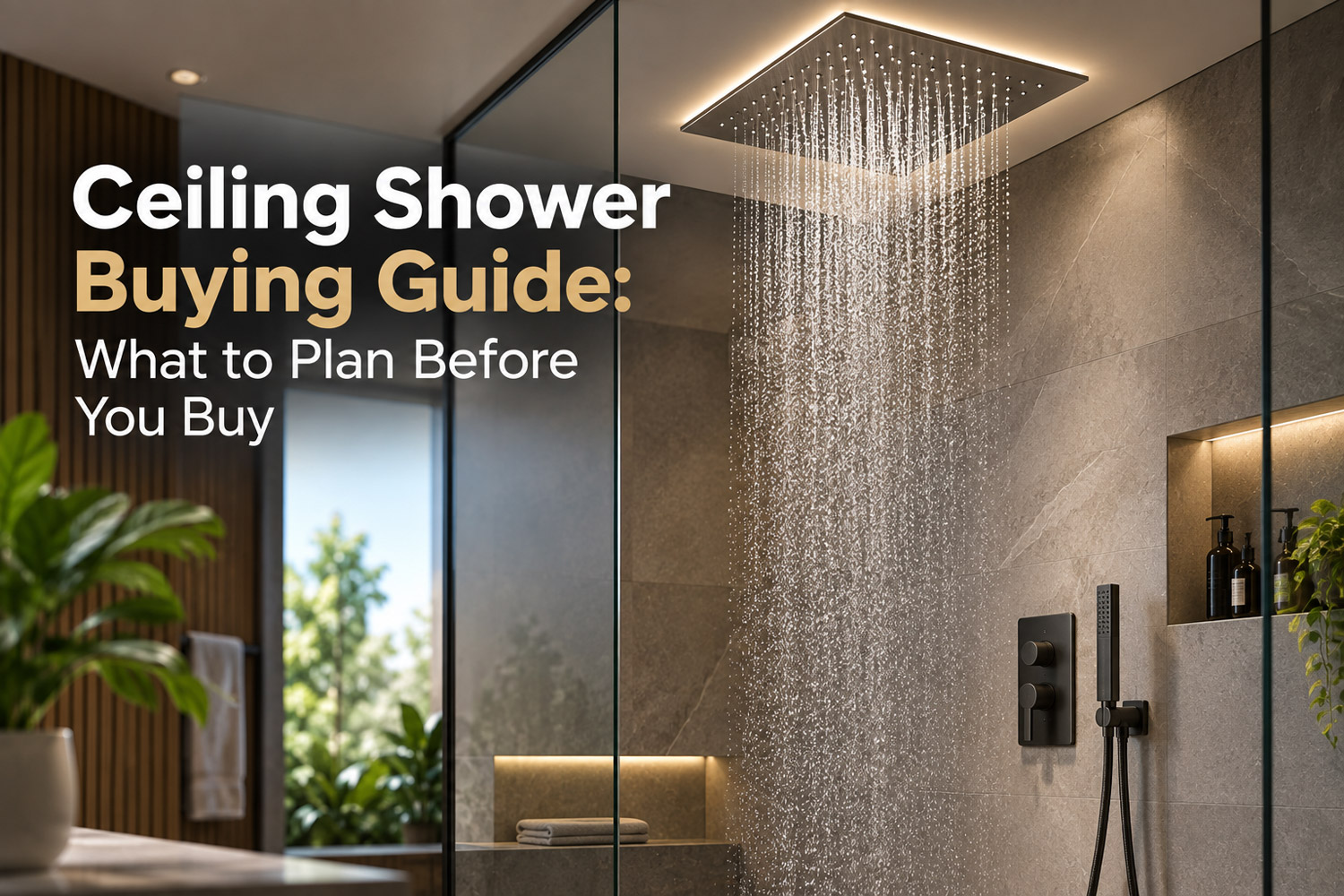
A ceiling shower is the closest thing a bathroom has to a centrepiece. Water falling straight down from above, covering you completely, with no visible pipework — it’s the image that sells more bathroom renovations than any other single fixture.
It’s also the fixture most likely to disappoint after installation, and almost always for the same reason: it was chosen before anyone checked whether the water supply could actually drive it.
A 400mm ceiling shower on inadequate pressure doesn’t rain. It dribbles. And by the time you discover that, it’s embedded in your ceiling.
This guide covers what to work out before you buy, not after.
Ceiling, Wall-Mounted, or Handheld?
These aren’t competing options — most well-designed showers use two or three together.
Ceiling Shower
Mounted overhead, pipework fully concealed.
Strengths: The cleanest visual result — nothing on the walls, nothing visible except the head itself. True vertical rainfall covering the whole body. Feels distinctly different from any wall-mounted alternative.
Considerations: Needs ceiling void and planning before the ceiling closes. Position is fixed permanently. You can’t easily avoid getting your hair wet, which matters more to some households than others.
Wall-Mounted Overhead
Mounted on an arm projecting from the wall.
Strengths: Far easier to install and retrofit. Angle is often adjustable. No ceiling work required.
Considerations: The arm is visible. Water falls at a slight angle rather than truly vertically.
Hand Shower
Handheld on a flexible hose.
Strengths: Essential for practical use — rinsing, cleaning the enclosure, washing children, bathing pets. Useful when you don’t want a full overhead soak.
Considerations: Not a primary shower experience on its own.
The realistic recommendation: a ceiling shower plus a hand shower covers almost every household need. That’s a 2-way system. Add body jets or a bath spout and you’re at 3-way. We cover how outlet count works in our guide to thermostatic shower mixers.
Water Pressure: Work This Out First
This is the section that determines whether your shower is excellent or disappointing, so do this before choosing anything.
Why Ceiling Showers Are Pressure-Sensitive
A handheld or wall-mounted shower directs water forward with some velocity. A ceiling shower relies largely on gravity — water falls through the head and down.
That means pressure isn’t creating force so much as ensuring the head fills evenly and every nozzle flows. Insufficient pressure on a large head produces partial coverage: some nozzles run, others trickle, and the rainfall effect never materialises.
Head Size vs Pressure
Larger head = more nozzles = more flow required for full coverage.
A 200mm head fills readily on modest pressure. A 500mm head needs substantially more to perform as intended.
This is why a smaller head on good pressure beats a larger head on poor pressure every time. An excellent 250mm ceiling shower is a far better outcome than a mediocre 500mm one.
Questions to Answer Before Buying
What floor are you on? Upper floors in gravity-fed buildings often have reduced pressure.
Is hot and cold pressure balanced? Unbalanced supply causes both temperature swings and poor performance, particularly with thermostatic systems.
How many outlets will run simultaneously? A ceiling shower plus four body jets needs considerably more flow than a ceiling shower alone.
What size is your geyser? A large ceiling shower empties a small storage heater quickly. Size the heater to the shower, not the other way round.
If Pressure Is Inadequate
Install a pressure pump. The standard solution, and effective. Plan for it at the design stage rather than adding it after disappointment.
Choose a smaller head. Often the smarter answer. A well-chosen 250mm head on natural pressure is genuinely satisfying.
Select a head designed for lower pressure. Some designs use nozzle geometry to produce a fuller effect on less flow. Worth asking about specifically.
Browse the shower range at NEXL, where ceiling showers are available across sizes to suit different supply conditions.
Sizing Your Ceiling Shower
| Head Size | Coverage | Pressure Need | Best For |
|---|---|---|---|
| 200mm | Focused | Low–moderate | Compact bathrooms, modest pressure |
| 250mm | Good body coverage | Moderate | Most residential bathrooms |
| 300mm | Full coverage | Moderate–good | Primary bathrooms with solid pressure |
| 400mm+ | Immersive | Strong | Large bathrooms, pumped supply |
The practical guidance: 250–300mm suits most Indian residential bathrooms. It delivers genuine rainfall coverage without demanding exceptional supply.
Go larger only if you’ve confirmed the pressure supports it. Photographs of vast ceiling showers are taken in bathrooms with commercial-grade water supply — that context doesn’t transfer.
Also consider bathroom proportion. A 500mm head in a compact bathroom looks oversized and out of scale, regardless of performance.
Ceiling Planning: Decide Before the Ceiling Closes
Ceiling showers are less forgiving than any other shower format, because everything happens above a surface that gets sealed.
Confirm Before Construction
Void depth. Typically 100–150mm for a recessed head plus pipework. Confirm the specific requirement for your chosen model — not a general figure.
Position. Where exactly will you stand? The head should sit over the standing area, not over the entry point or hard against a wall. Mark it on the floor and look up before finalising.
Pipe routing. Supply lines run through the ceiling void to the head. Route and access must be planned.
Ceiling height. Standard bathroom ceiling height works fine. Unusually low ceilings may make a recessed head feel oppressive; unusually high ones reduce the sense of enclosure.
Access provision. Ideally leave a way to reach the connection — an access panel or removable section. Not always practical, but valuable if it is.
Power, if you’re choosing LED. Illuminated heads need a supply run to the ceiling position. Decide early.
The Recurring Rule
Every concealed fixture follows the same logic: the decisions are cheap before the surface closes and expensive afterwards. It applies to concealed cisterns, to in-wall thermostatic valves, and to ceiling showers equally.
If you’re even considering a ceiling shower, run the pipework. An unused capped connection costs almost nothing.
LED Ceiling Showers
Some ceiling showers include integrated LED lighting that illuminates the falling water.
What they offer: A genuinely striking effect, particularly in bathrooms designed for evening use. Colour-changing options can shift with water temperature on some models, which doubles as a subtle temperature indicator.
Honest assessment: This is an experiential feature, not a functional one. It doesn’t improve how the shower washes you. If the choice is between a better-engineered head without LED and a lesser one with it, choose the engineering.
If you do want it: confirm the power requirement and how the lighting unit is serviced. Anything electrical in a ceiling void should be accessible.
Where it works best: Primary bathrooms designed as a retreat, and bathrooms where ambient lighting is part of the scheme rather than an afterthought.
Explore LED and standard ceiling showers in the NEXL range.
Adding Body Jets
Body jets are wall-mounted nozzles directing horizontal spray at the body — typically installed in a vertical column or in pairs at different heights.
What they add: A genuinely different sensation to overhead water. Directed spray at the back and shoulders, which is what makes a shower feel restorative rather than functional.
What they require:
Significantly more flow. Four body jets running with a ceiling shower is a substantial simultaneous draw. This is where inadequate supply becomes most obvious.
Wall planning. Positions must be fixed before tiling, at heights that suit the people using the shower.
A multi-way valve. Body jets need their own outlet, which means a 3-way system minimum.
The honest guidance: body jets are excellent when the supply supports them and disappointing when it doesn’t. If pressure is marginal, spend the budget on a better ceiling shower and thermostatic valve instead. A great two-outlet shower beats a weak four-outlet one.
What Makes a Quality Ceiling Shower
Silicone or rubber nozzles. The most important maintenance feature. Flexible nozzles release limescale when rubbed with a finger. Rigid metal nozzles clog permanently in hard water — which includes Ahmedabad.
Solid brass or quality stainless construction. Thin pressed metal heads flex, corrode at joints, and eventually leak.
Even nozzle distribution. Coverage should be consistent across the head, not concentrated at the centre with sparse edges.
Adequate internal chamber. The water distribution chamber inside the head affects how evenly it fills. This is engineering you can’t see, which is why brand and build quality matter.
Serviceable connection. You should be able to access the connection if something needs attention.
Finish quality. PVD-coated for coloured finishes. The same principles apply as with faucet finishes in hard water — brushed finishes hide spotting, and matte black shows it.
Coordinating the Shower Zone
A ceiling shower is one element of a shower area that needs to work as a whole.
Thermostatic control. A large ceiling shower makes temperature stability more noticeable, not less — you’re under full body coverage, so a sudden change is felt immediately. Thermostatic valves are strongly advisable here.
Shower niche. Recessed wall storage keeps bottles off the floor and out of the water path. Must be planned before tiling. Shower niches including illuminated options are available at NEXL.
Finish consistency. Ceiling shower, hand shower, valve trim, body jets, and basin fittings should share one finish family.
Drainage. A ceiling shower delivers substantial water volume. Confirm your drain and floor gradient handle it — inadequate drainage causes pooling that no amount of good fittings will fix.
Maintenance in Hard Water
Wipe the nozzles regularly. With silicone nozzles, running a finger across them dislodges deposits before they establish. Thirty seconds, monthly.
Watch for uneven spray. Individual nozzles trickling while others flow properly means limescale. Address it early.
Don’t use acidic descalers on the finish. Same rule as faucets — they remove the limescale and damage the finish. Mild soap and gentle physical cleaning only.
Consider an inline filter. In Gujarat’s water conditions, filtration extends the life of every shower component meaningfully.
Common Mistakes
Choosing head size before checking pressure. The most common error, and the one that produces the most disappointment.
Deciding position after the ceiling is built. Mark the standing position and confirm the head sits above it before construction.
Specifying more outlets than the supply can run. Four jets plus a ceiling shower needs real flow. Confirm it exists.
Forgetting geyser capacity. A large ceiling shower drains a small storage heater fast.
Rigid metal nozzles in a hard water area. They will clog, and you won’t be able to clear them.
Planning the niche after tiling. It has to be built into the wall structure.
See It Running Before You Buy
Specifications describe a ceiling shower. They don’t tell you how the water feels, how a 250mm head compares to a 400mm one in person, or whether a finish looks right against your tiles.
At NEXL’s Experience Center in Ahmedabad, ceiling showers are displayed alongside compatible thermostatic systems and coordinating fittings — so you can compare sizes, see finishes properly, and get guidance from a team that will ask about your water pressure before recommending anything.
NEXL Experience Center 111, Sun Orbit, Rajpath Rangoli Road, PRL Colony, SBR, Ahmedabad, Gujarat – 380059
Walk-ins welcome. For renovation projects or trade enquiries, get in touch to arrange a consultation.
Explore online:
FAQ’s
Q: Can I add a ceiling shower without a false ceiling?
A: You need void space for the pipework. Without a false ceiling, this means cutting into the structural ceiling — usually impractical. A wall-mounted overhead shower achieves a similar effect with far less disruption.
Q: Will a ceiling shower work with a pressure pump?
A: Yes, and a pump is the standard solution for inadequate supply. Size it to the total flow of all outlets running together, and plan it at design stage rather than adding it afterwards.
Q: How do I stop my hair getting wet in a ceiling shower?
A: You largely can’t — that’s inherent to overhead rainfall. This is exactly why a hand shower alongside is worth including. Many households use the hand shower more often than the ceiling head.
Q: Are LED ceiling showers reliable?
A: Quality units are, but anything electrical in a ceiling void should be accessible for service. Confirm the power requirement and access provision before installation.
Q: What’s the ideal ceiling shower height?
A: Standard bathroom ceiling height works well. The head should clear the tallest user comfortably. For recessed heads, the ceiling height itself determines this — plan the void depth accordingly.
Q: Can I run a ceiling shower and body jets at the same time?
A: Only with sufficient flow. Many multi-outlet systems are designed for switching between outlets rather than running all together. Confirm the intended operation with your supplier before purchase.
A ceiling shower is one of the few bathroom fixtures where the experience genuinely justifies the planning it demands.
But it rewards honesty about your water supply more than it rewards ambition about head size. Confirm the pressure, choose the head that suits it, and plan the ceiling before it closes.
Do those three things and it’s the fixture you’ll appreciate every morning.
Explore the full shower range at nexl.in/product-category/showers/