
There is a moment in a lot of bathroom renovations that catches people out.
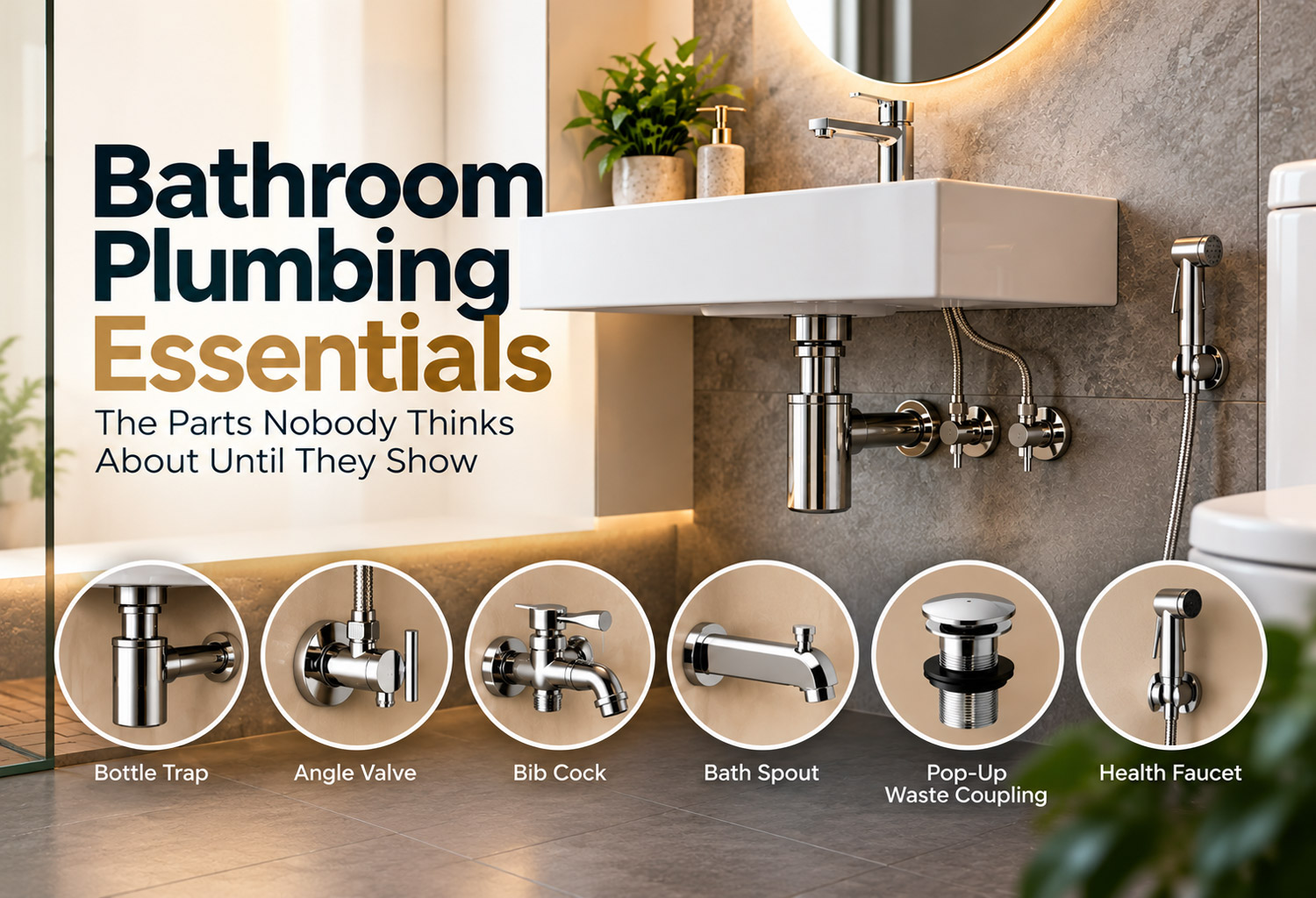
The basin goes up, wall hung and beautiful, and then everyone looks underneath. There is a chrome trap hanging below a matte black faucet, connected to two chrome angle valves, and the whole thing suddenly looks like it was finished by someone else.
Nobody chose that. It just arrived with the plumber, because nobody had specified anything different.
These parts get treated as plumbing rather than product, which is fine when they are hidden inside a vanity. The moment they are on show, they are as much a design decision as the faucet above them.
Here is what each one does, and which of them you actually need to think about.
Bottle Traps
What it is
The trap is the curved section below the basin that holds a small amount of standing water. That water seal is what stops drain odour coming back up into the room.
A bottle trap does the same job as a traditional P-trap but in a compact cylindrical form, which is why it has become standard under wall hung and pedestal basins. It looks deliberate rather than industrial.
Why it matters more than people expect
Under a vanity unit, nobody sees it. Under a wall hung basin, it is at eye level for anyone sitting down and fully visible from across the room.
If your basin is wall hung, the trap needs to match your faucet finish. Chrome trap, chrome faucet. Matte black faucet, matte black trap. This is the single most common finish mismatch in otherwise well-executed bathrooms, and it happens because the trap gets ordered by the plumber rather than specified by whoever chose everything else.
What to look for
Brass construction. Same reasoning as any wet-area fitting. Brass handles constant moisture without corroding. Plastic traps work but look it, and they discolour over time.
Finish matched to your fittings. Decide it alongside the faucet, not afterwards.
Accessible for cleaning. Bottle traps collect hair and residue. A unit that unscrews by hand saves you a call-out.
Correct size for your waste outlet. Standard sizing covers most basins, but confirm against your specific basin before ordering.
Browse bottle traps and waste fittings in the allied range.
Pop-Up Waste Couplings
What it is
The waste is the drain fitting in the basin itself. A pop-up waste has a push mechanism that seals the basin so it can hold water, then releases with another push.
The detail that causes problems
Overflow or no overflow.
Most basins have an overflow hole near the rim. Some designer basins, particularly table top and vessel types, have none at all.
These need different wastes. A waste designed for an overflow basin has a slot in its body to let that channel drain. Fit one to a basin without an overflow and you get a leak path. Fit a non-overflow waste to a basin with an overflow and the overflow cannot drain.
Check your basin before ordering the waste. It takes ten seconds and it is a surprisingly common error.
What to look for
Brass body, finish matched to the faucet, and a mechanism that seals properly rather than slowly letting water down.
Angle Valves
What it is
An angle valve is the small shut-off valve between the wall supply and your fitting. It lets you isolate one faucet without turning off water to the whole house.
Why they are worth caring about
Two reasons.
Practical. When a faucet needs servicing, an angle valve means you shut off that one fitting. Without one, the whole supply goes off. Anyone who has done plumbing work in a house with no isolation valves knows the difference.
Visual. Under a wall hung basin, the angle valves are visible alongside the trap. Two chrome valves under a brushed gold faucet undo the effect just as effectively as a mismatched trap.
What to look for
Quarter-turn ceramic operation. Turns smoothly, seals properly, and does not seize after years of sitting untouched. Cheaper valves with rubber seals stiffen and eventually will not close when you need them to.
Brass body. These sit permanently connected to the water supply. Material quality is not optional here.
A flange. The flange is the decorative cover plate that hides the rough wall penetration. Without it you see the hole.
Finish matched to the room. Same rule as everything else visible.
NEXL offers angle valves in standard and shaped profiles, including curve, D and triangle forms for projects where the valve is on display and the detail matters. The full selection is in the allied range.
Bib Cocks
What it is
A bib cock is a wall-mounted tap with a short spout, used where you need water but not a mixer. Utility areas, service spaces, and washing machine supply points.
A 2-in-1 bib cock adds a second outlet, so one wall connection feeds both the tap and a hose or appliance. It saves a separate connection point in tight spaces.
What to look for
Brass body, quarter-turn operation, and a flange for the wall penetration. Simple product, and the specification that matters is the same as everywhere else.
Health Faucets
What it is
The handheld spray beside the toilet, sometimes called a bidet spray or jet spray. Standard in nearly every bathroom in India.
What usually fails first
Not the faucet. The tube and the hook.
Cheap tubes kink, crack at the connection, and eventually leak. Flimsy hooks snap or pull out of the wall. The spray head itself usually outlasts both.
Buy it as a set. A health faucet with a properly specified tube and hook costs slightly more and lasts considerably longer than a good spray head on a poor tube.
What to look for
Brass or quality stainless spray head with a lever that returns cleanly and does not weep when released.
Reinforced tube with proper connection fittings at both ends.
Solid wall hook that holds the spray securely without flexing.
Finish matched to the rest of the bathroom, since this one sits in plain view beside the toilet.
A note on smart toilets
If you are considering a smart toilet, the integrated bidet wash does the same job with temperature and pressure control, and a self-cleaning nozzle. Many households keep a health faucet anyway for general bathroom cleaning, which is a reasonable use for it.
Bath Spouts
What it is
The outlet that fills a bathtub. Wall mounted, usually paired with a separate mixer or a concealed valve.
Plain or diverter
Plain spout. Water out, nothing else. Correct when a separate valve controls the switch between tub and shower.
Tip-ton diverter spout. A small lever on the spout itself switches flow between the spout and the shower outlet. Useful when you want one control point rather than a separate diverter valve in the wall.
Which you need depends on how your shower system is configured, so decide it alongside the shower system rather than separately.
What to look for
Adequate reach. The water should land well inside the tub, not against the inner wall or over the rim. Measure your tub before ordering.
Smooth internal bore. Affects how the water flows out. Cheap spouts produce a split or spitting stream rather than a clean one.
Diverter quality, if you are using one. The mechanism switches thousands of times over the life of the bathroom.
Where These Fit in the Specification
Most of these are straightforward to order once you know what you need, which makes them well suited to buying online. Our accessories and allied ranges are now on Amazon India alongside the website.
Two things to settle before you order anything:
Finish. Everything visible goes in the same finish family as your faucets. Trap, angle valves, health faucet, bath spout. If you are unsure which finishes handle Ahmedabad’s hard water best, our guide to faucet finishes for hard water covers it.
Compatibility. Waste type against basin overflow, spout reach against tub size, trap size against waste outlet. All measurable, all quick to confirm, all annoying to get wrong.
What Usually Goes Wrong
A chrome trap under a coloured faucet. The most common one, and entirely avoidable by specifying the trap with the faucet.
Angle valves left as default. Visible under a wall hung basin, and nobody chose them.
Wrong waste for the basin. Overflow and non-overflow wastes are not interchangeable.
Health faucet bought as a spray head only. The tube fails first.
Bath spout with too little reach. Water runs down the inside of the tub instead of filling it properly.
No angle valves at all. Every future repair becomes a whole-house water shutdown.
Quick Reference
| Part | Visible? | Decide alongside |
|---|---|---|
| Bottle trap | Yes, under wall hung basins | The basin faucet |
| Pop-up waste | Partly, in the basin | The basin, checking overflow |
| Angle valves | Yes, under wall hung basins | The basin faucet |
| Bib cock | Usually in utility areas | Nothing, standalone |
| Health faucet | Yes, beside the toilet | The toilet and overall finish |
| Bath spout | Yes | The shower system |
See Them Alongside Everything Else
The reason these parts end up mismatched is that they get chosen separately, usually by whoever is installing rather than whoever designed the bathroom.
At the NEXL Experience Center in Ahmedabad, traps, valves, spouts and health faucets are displayed with the faucets and sanitaryware they pair with, so finish matching happens at the specification stage instead of being discovered on installation day.
NEXL Experience Center 111, Sun Orbit, Rajpath Rangoli Road, PRL Colony, SBR, Ahmedabad, Gujarat 380059
Walk-ins welcome. For renovation projects or trade enquiries, get in touch.
Browse: Allied Range · Bath Faucets · Basins and Bathtubs · Showers
Frequently Asked Questions
What is a bottle trap used for?
It holds a water seal below the basin that stops drain odour entering the room. A bottle trap does the same job as a traditional P-trap in a compact cylindrical shape, which is why it is standard under wall hung and pedestal basins where the trap is visible.
Does a bottle trap need to match the faucet finish?
Under a wall hung or pedestal basin, yes. It is fully visible, so a chrome trap under a matte black faucet is immediately noticeable. Under a vanity unit it is hidden and matters much less.
Why do I need angle valves?
They let you shut off water to one fitting instead of the whole house. Without them, any future repair to a single faucet means isolating the entire supply. Under a wall hung basin they are also visible, so finish matters too.
What is the difference between a bib cock and a tap?
A bib cock is a wall-mounted tap with a short spout, typically used in utility areas rather than over a basin. A 2-in-1 version adds a second outlet so one connection can feed both a tap and an appliance or hose.
Which health faucet should I buy?
Buy it as a set with the tube and hook included. The spray head usually outlasts both, so a quality head on a cheap tube fails at the tube. Look for a reinforced tube and a hook solid enough not to flex.
Do I need a bath spout with a diverter?
Only if you want to switch between tub and shower at the spout. If a separate valve already controls that, a plain spout is correct. Decide it with your shower system rather than on its own.
How do I know which pop-up waste fits my basin?
Check whether your basin has an overflow hole near the rim. Basins with an overflow need a slotted waste; basins without need an unslotted one. They are not interchangeable.
Worth Ten Minutes
None of these parts are interesting, and that is exactly why they get left to chance.
Spend ten minutes on them at the specification stage and they disappear into the bathroom the way they should. Leave them to installation day and they become the thing your eye goes to every time you walk in.
Browse the full allied range at nexl.in/product-category/allied-series/