
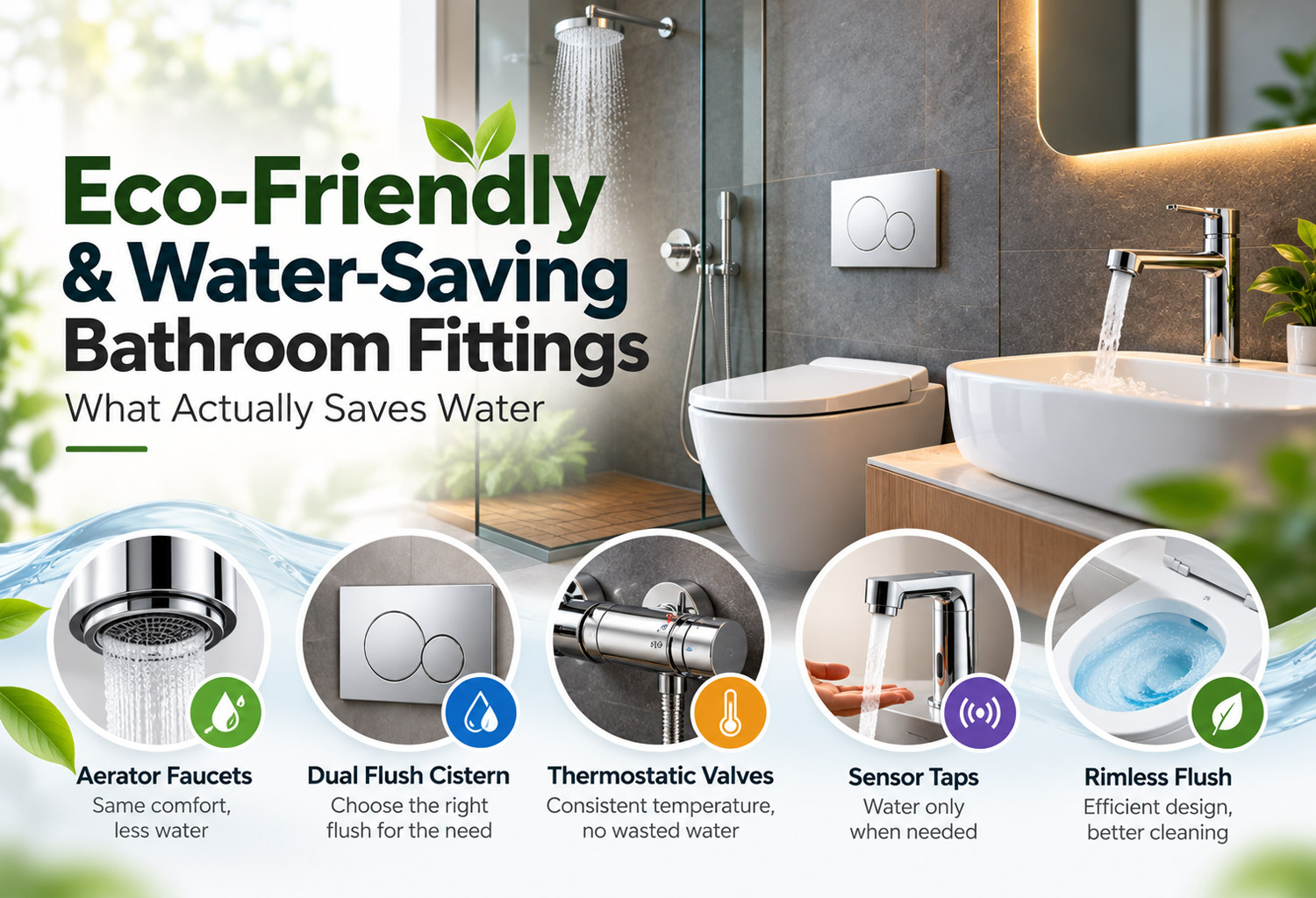
Most products marketed as eco-friendly in a bathroom are not doing very much.
A label saying water-efficient means nothing on its own. What matters is the mechanism inside, and whether that mechanism reduces water use without making the product worse to use. Plenty of low-flow fittings save water by simply being weak, which is why people end up replacing them or working around them.
The fittings that genuinely help do it in a way you do not notice. Here is how each one works, and which ones are worth specifying.
The Aerator: Small Part, Most Impact
If you change one thing in a bathroom, change this.
How it works
An aerator is the mesh insert at the faucet outlet. It draws air into the water stream, which does two things at once. It increases the apparent volume of water coming out, and it reduces the actual volume.
The stream feels full because it is mostly air. Your hands get wet just as quickly, but less water goes down the drain.
Why it matters more than anything else in the bathroom
A basin faucet is used dozens of times a day in a household. Brushing teeth, washing hands, rinsing something. Each use is short, which makes it easy to dismiss, but the cumulative total across a year is substantial.
Reducing flow at the basin faucet affects more individual water events than any other fitting in the house.
What to look for
A branded aerator. Neoperl is the benchmark, and quality faucets specify it rather than fitting a generic insert. The mesh geometry matters for both flow shaping and scale resistance.
Removable for cleaning. In hard water, which covers most of Gujarat, a clogged aerator distorts the stream and people compensate by opening the tap further. That cancels the saving entirely. One that unscrews easily stays effective.
A published flow rate. Check the specification rather than the marketing. A fitting that states its flow rate is telling you something. One that only says eco-friendly is not.
Most faucets in the NEXL range are specified with Neoperl aerators. Browse the bath faucets range.
Dual Flush: The Obvious One, Done Properly
How it works
Two buttons, two volumes. A full flush for solids, a reduced flush for liquids.
The saving is straightforward. Most flushes in a household only need the reduced option, and the reduced flush uses considerably less water than a full one.
Where it goes wrong
Two things undermine dual flush in practice.
A flush that does not stop cleanly. Cheap mechanisms continue trickling after the flush completes, which quietly undoes the saving. The cistern refills continuously and nobody notices, because the sound is faint and constant.
Poor bowl design forcing double flushes. If the bowl does not clear properly on a reduced flush, people press the full button out of habit, or flush twice. Either way the saving is gone.
This is why bowl design and flush mechanism have to be considered together rather than separately.
The rimless connection
A rimless bowl has no hidden inner rim, so flush water sweeps the entire bowl surface rather than being distributed through small holes beneath a ledge.
That means a given volume of water does more work. A rimless bowl on a reduced flush clears more reliably than a conventional rimmed bowl on the same volume, which is what makes dual flush actually get used as intended rather than ignored.
We cover the hygiene side of this in the rimless washdown toilet guide. For the cistern side, the concealed cistern guide explains what separates a good mechanism from a cheap one.
Browse rimless toilets and the wider sanitaryware range.
Thermostatic Valves: The Saving Nobody Counts
This is the one almost no sustainability guide mentions, and it is genuinely significant.
The waste that happens before the shower starts
With a manual mixer, you turn the water on and then adjust. Too hot, too cold, then somewhere in between. All of that water goes straight down the drain while you are still deciding.
Then something changes elsewhere in the plumbing, the temperature shifts, and you adjust again.
How thermostatic control changes it
A thermostatic valve holds the temperature you set, regardless of pressure changes elsewhere in the house. You set it once and it stays there, which means two things.
No run-off while adjusting. The water is at temperature from the start.
No mid-shower corrections. A toilet flushing elsewhere does not change your shower temperature, so you are not reaching for the control and wasting water while re-finding the setting.
Nobody measures this, because it is spread across hundreds of short events rather than appearing as one obvious waste. But in a household where several people shower daily, it adds up.
Our comparison of thermostatic and manual mixers covers how the valve works mechanically. Browse the thermostatic range.
Sensor Taps: Water Only When Needed
How it works
A sensor detects a hand and runs water only while it is present. The moment you move away, the flow stops.
Where it makes the biggest difference
Commercial and shared washrooms. This is where sensor taps earn their place decisively. In an office or restaurant washroom, taps get left running, and a single tap left on overnight wastes more than months of careful domestic use. Sensor operation removes that failure mode entirely.
Households with children. Taps left running is a daily occurrence rather than an occasional one.
Any basin where hands are dirty. You are not touching a handle, which also means there is nothing to clean.
The commercial case extends to urinals
Sensor urinals apply the same logic to a fixture that, in a conventional installation, often flushes on a timer whether or not anyone has used it. Sensor operation means flushing happens on use rather than on schedule.
For offices, hotels and restaurants, this is the clearest water-saving specification decision available. Browse sensor urinals and sensor basin mixers in the bath faucets range.
What Does Not Save Water
Being clear about this matters, because a lot of green marketing in this category is noise.
A low-flow label with no stated flow rate. If the specification does not say what the flow rate is, the label is decoration.
A restrictor washer instead of a proper aerator. Some fittings reduce flow by simply narrowing the opening. That saves water and makes the fitting unpleasant to use, which is why people remove the restrictor and lose the saving.
A dual flush cistern with a poor bowl. If the reduced flush does not clear the bowl, nobody uses it.
Eco-friendly packaging. Pleasant, but it has nothing to do with how much water the product uses over fifteen years.
The Longevity Argument
There is a second environmental dimension that gets far less attention than water use, and it is arguably larger.
A fitting that lasts fifteen years has a considerably smaller total footprint than three fittings that last five years each. Manufacturing, shipping, packaging and disposal all happen once rather than three times.
This is where build quality and sustainability point in the same direction. Solid brass bodies, ceramic disc cartridges and PVD finishes are specified for durability, and durability is the least discussed form of environmental benefit.
The same logic applies to serviceability. A fitting whose cartridge, aerator and seals can be replaced stays in use. One that has to be discarded when a single component fails does not. Confirming spare parts availability is an environmental question as much as a practical one.
Our guide to choosing premium bathroom fittings covers what to check on materials and serviceability.
Hard Water, and Why It Matters Here
In Ahmedabad and most of Gujarat, hard water affects every point above.
Aerators clog. A scaled aerator distorts the stream, and people respond by opening the tap further. The water saving disappears and nobody realises why.
Cistern mechanisms stiffen. Scale on the flush valve is a common cause of the continuous trickle that silently wastes water.
Thermostatic cartridges degrade faster. Which affects both performance and the run-off saving described above.
Two practical responses. Specify fittings with aerators designed to shed scale, often silicone-nozzle types that release deposits when rubbed with a finger. And consider an inline filter, particularly for thermostatic systems and anything with internal components that are harder to reach.
Our faucet finish guide for hard water covers aerator maintenance in more detail.
Specifying an Efficient Bathroom
In rough order of impact:
| Priority | Fitting | Mechanism |
|---|---|---|
| 1 | Basin faucet with a quality aerator | Highest frequency of use |
| 2 | Dual flush cistern with a rimless bowl | Largest single volume per use |
| 3 | Thermostatic shower valve | Eliminates adjustment run-off |
| 4 | Sensor taps, where appropriate | Removes left-running waste |
| 5 | Durable, serviceable fittings throughout | Reduces replacement footprint |
For commercial projects, reorder this. Sensor operation moves to the top, because the dominant waste in a shared washroom is taps left running rather than individual flow rates.
See the Specifications in Person
Flow rates, flush volumes and valve behaviour are specification questions, and they are easier to work through with the products and datasheets in front of you.
At the NEXL Experience Center in Ahmedabad, faucets, cisterns and thermostatic systems are displayed together, so efficiency can be considered alongside everything else rather than as an afterthought.
NEXL Experience Center
111, Sun Orbit, Rajpath Rangoli Road, PRL Colony, SBR, Ahmedabad, Gujarat 380059
Walk-ins welcome. For renovation or commercial projects, get in touch.
Browse: Bath Faucets · Thermostats · Sanitaryware · Rimless Toilets · Smart Urinals
Frequently Asked Questions
What are eco-friendly bathroom fittings?
Fittings that reduce water use through a specific mechanism rather than a label. The main ones are aerators that mix air into the stream, dual flush cisterns with two volumes, thermostatic valves that remove temperature adjustment run-off, and sensor taps that run only when hands are present.
Do water-saving faucets have weak flow?
A properly designed one does not. An aerator maintains the feel of a full stream by drawing air in, so your hands get wet just as fast. Fittings that simply restrict the opening do feel weak, which is why people often remove the restrictor and lose the saving entirely.
How much water does a dual flush toilet save?
The reduced flush uses considerably less than a full flush, and most household flushes only need the reduced option. Actual volumes vary by model, so check the specification. A bowl that clears properly on the reduced flush matters as much as the cistern, because a bowl needing a second flush saves nothing.
Are sensor taps worth it in a home?
In most homes the saving is modest, since adults turn taps off. They are worth considering in households with young children, and they make a clear difference in commercial or shared washrooms where taps get left running.
Does a thermostatic shower save water?
Yes, in a way that rarely gets measured. You are not running water while adjusting the temperature, and you are not re-adjusting mid-shower when pressure changes elsewhere. Across a household it adds up.
Does hard water affect water-saving fittings?
Significantly. A scaled aerator distorts the stream, and people open the tap further to compensate, which cancels the saving. Choose aerators designed to shed scale, clean them every few months, and consider an inline filter.
Is a durable fitting more environmentally friendly than a water-saving one?
They are not in competition, and the best fittings are both. But a fitting lasting fifteen years has a far smaller total footprint than three replacements over the same period, and that dimension is usually left out of the conversation entirely.
Conclusion
Ignore the labels and look at the mechanism.
An aerator, a dual flush cistern with a bowl that actually clears, a thermostatic valve, and fittings built to last are the four decisions that matter. Most of the rest in this category is marketing.
Browse water-efficient faucets at nexl.in/product-category/bath-faucets/